INTRODUCTION: The Reality of Personal Safety and stab prevention
In United Kingdom and most European cities, the conversation around personal safety has shifted, and the statistics surrounding knife-related incidents continue to paint a sobering picture of urban life. For many, the question is no longer “if” they should consider protective measures, but “how” they can best safeguard themselves and their loved ones without compromising their lifestyle or comfort.
The Rising Tide of Knife Crime in the UK and Europe
According to the latest data from the Office for National Statistics (ONS) and recent parliamentary briefings, knife crime in England and Wales has seen a persistent upward trend over the last several years. In the reporting year ending September 2025 and early 2026, police-recorded offences involving a knife or sharp instrument reached levels that have sparked nationwide debate and urgent policy reviews. Major metropolitan areas, particularly London, Birmingham, and Manchester, remain hotspots where the frequency of these incidents has created a palpable sense of unease among residents.
The nature of these crimes has also evolved. While gang-related violence remains a significant factor, there is an increasing number of “opportunistic” or “random” incidents involving bladed weapons. This shift means that ordinary citizens—commuters, retail workers, delivery drivers, and even students—are finding themselves in situations where the threat of a knife is a real, albeit terrifying, possibility. The psychological impact of this environment cannot be understated; it affects how people move through their cities, which routes they take, and their overall sense of well-being.
Why Everyday Protection is required for your loved ones
For a long time, the concept of “body armour” was reserved for the police, military, or high-level private security. The image that came to mind was one of heavy, bulky, and conspicuous vests that were impossible to hide under normal clothing. However, as the threat landscape has changed, so too has the technology designed to counter it. We are now in an era where “everyday protection” is not just a niche requirement for professionals but a practical solution for anyone concerned about their safety.
The transition from tactical gear to “stab-proof clothing” represents a significant leap in textile engineering. It acknowledges that the best protection is the one you actually wear. A heavy vest sitting in a wardrobe offers zero protection during a late-night walk home or a confrontation at a workplace. This is where the innovation of stab-proof t-shirts, hoodies, and discreet base layers comes into play. They offer a “silent” layer of security that integrates seamlessly into a standard wardrobe, providing peace of mind without drawing unwanted attention.
Introducing the Solution: Stab-Proof Clothing
Stab-proof clothing is designed to provide a defensive barrier against various sharp-force threats, including knives, spikes, and needles. Unlike traditional ballistic vests (which are designed to stop bullets), stab-resistant garments focus on the unique physics of a blade’s penetration. They use advanced materials—most notably Ultra-High-Molecular-Weight Polyethylene (UHMWPE)—to catch, slow down, and ultimately stop a blade from reaching the wearer’s skin.
However, the market for this clothing is fraught with misinformation, uncertified products, and “too good to be true” claims. This guide is designed to cut through the noise. We will explore the science of stab resistance, debunk common myths, and provide you with the knowledge needed to make an informed decision about your personal safety.
StabApparel: Leading the Way in UK & Europe
When it comes to reliable, certified, and wearable protection, one name has consistently risen to the top of the UK and European markets: StabApparel. By focusing on the intersection of high-level safety standards and everyday comfort, StabApparel has redefined what it means to be “protected.” Their commitment to using the highest grade UHMWPE and rigorous testing protocols has made them the go-to choice for both professionals and private individuals across the continent. Throughout this guide, we will look at why their approach to “discreet protection” is setting the standard for the industry in 2026.

Full Stab Proof T-Shirt
SECTION 1: What Is Stab-Proof Clothing (And What It Is NOT)
To understand how to protect yourself, you must first understand the terminology. In the world of personal safety, words like “stab-proof,” “stab-resistant,” “cut-proof,” and “bulletproof” are often used interchangeably, but they represent vastly different levels of protection and engineering. Misunderstanding these terms can lead to a false sense of security, which is arguably more dangerous than having no protection at all.
Defining Stab-Resistant vs. Stab-Proof
The term “stab-proof” is a misnomer that has become common in everyday language. In reality, no material is 100% “proof” against every possible threat. A sufficiently powerful strike with a specialized tool or a high-velocity impact can eventually penetrate almost any flexible material. Therefore, the industry standard term is stab-resistant.
Stab-resistant clothing is engineered to provide a specific level of resistance against penetration from sharp objects like knives, spikes, and needles. The goal is to prevent the blade from reaching the wearer’s vital organs or causing deep, life-threatening lacerations. When we say “stab-proof” in this guide, we are referring to high-level stab-resistant garments that have been tested and certified to stop common street-level threats.
The Myth of “100% Protection”
One of the most dangerous claims a manufacturer can make is that their clothing offers “100% protection.” This is a myth for several reasons:
1.Coverage: No garment covers 100% of the body. Even a full-sleeve hoodie leaves the face, neck, and lower extremities exposed.
2.Force: Protection is rated based on “joules” of energy. A strike that exceeds the rated energy level of the garment may still cause injury.
3.Angle of Attack: While modern materials are designed to handle various angles, an extremely precise or unusual strike could potentially find a weak point in the weave or construction.
The purpose of stab-resistant clothing is to mitigate risk and increase the chances of survival. It turns a potentially fatal wound into a survivable injury or, in many cases, prevents the injury entirely.
Stab vs. Cut vs. Bulletproof: Knowing the Difference
It is crucial to distinguish between these three types of protection, as they require different materials and constructions:
| Feature | Cut-Resistant | Stab-Resistant | Bulletproof (Ballistic) |
| Primary Threat | Slashes, sliding blades | Stabs, thrusts, spikes | Bullets, high-velocity projectiles |
| Material Action | Resists being sliced | Catches and stops the point | Deforms and absorbs kinetic energy |
| Common Materials | Kevlar, HPPE, Glass fiber | UHMWPE, Steel mesh, Aramid | Ceramic plates, Thick Aramid layers |
| Flexibility | Very high (like a normal shirt) | Moderate to high (specialized) | Low to moderate (often bulky) |
Cut-resistant clothing is designed to stop a blade from “slicing” through the fabric. It is excellent for preventing superficial wounds but offers almost zero protection against a forceful “stab” or “thrust.” Many cheap products sold online are merely cut-resistant but are marketed as “stab-proof,” which is a lethal deception.
Bulletproof vests are designed to stop high-velocity projectiles. While some ballistic vests also offer stab resistance (known as “dual-threat” vests), many do not. A bulletproof vest made solely of soft aramid fibers can often be easily penetrated by a sharp knife or a thin spike because the fibers are designed to “catch” a blunt bullet, not a sharp point that can push between the weaves.
Understanding NIJ Standards Simply
To ensure a garment actually works, it must be tested against a recognized standard. The most widely accepted is the NIJ Standard 0115.00 (National Institute of Justice). This standard categorizes protection into three levels based on the amount of energy (measured in Joules) the armour can withstand:
•Level 1: Designed for low-threat environments (e.g., general street wear). It is tested to withstand an impact energy of 24 Joules (E1) and an overtest of 36 Joules (E2).
•Level 2: Designed for higher-threat environments (e.g., security personnel). It withstands 33 Joules (E1) and 50 Joules (E2).
•Level 3: The highest level of flexible protection, designed for extreme-risk scenarios. It withstands 43 Joules (E1) and 65 Joules (E2).
When choosing stab-proof clothing, always look for certification. If a product doesn’t mention NIJ levels or the UK Home Office equivalent (KR1, KR2, KR3), it is likely not a professional-grade safety product.
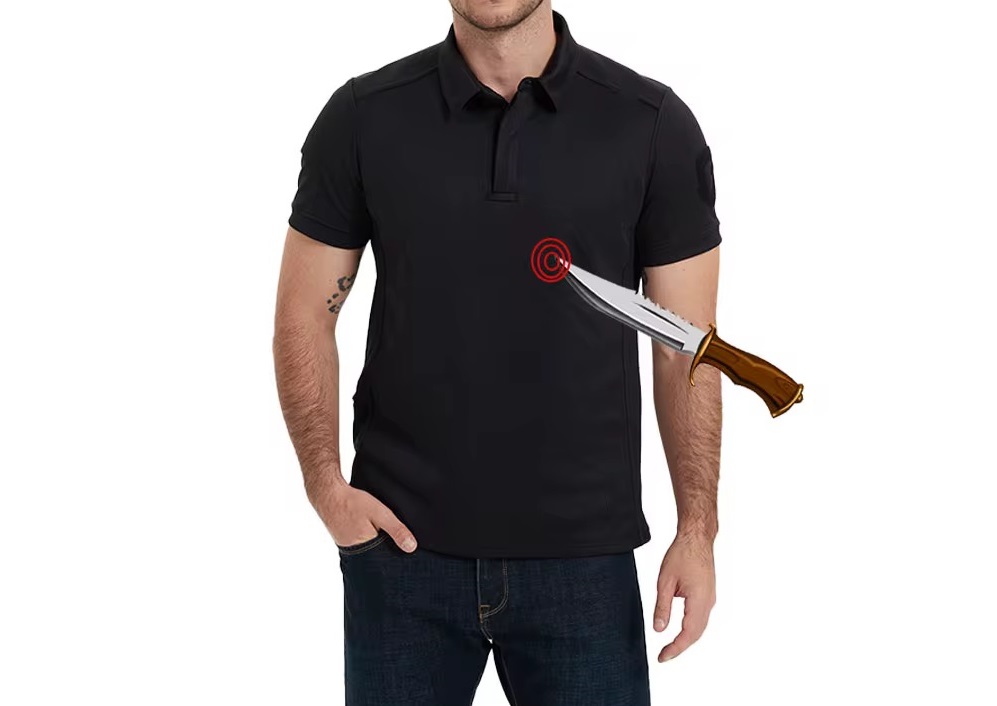
Full Stab Proof Polo T Shirt
SECTION 2: Why Most Stab-Proof Clothing FAILS
The surge in demand for personal safety gear has led to a flooded market. Unfortunately, many of the products available today—especially those found on large e-commerce platforms—are fundamentally flawed. Understanding why these products fail is the first step in ensuring you don’t waste your money on a false sense of security.
The “Amazon Trap”: Why Cheap Stab-Proof Shirts Don’t Work
If you search for “stab-proof t-shirt” on Amazon or similar sites, you will find dozens of options priced between £30 and £80. These products often feature impressive-looking videos of someone slashing a sleeve with a box cutter. However, these are almost always cut-resistant garments, not stab-resistant.
The failure of these cheap products usually stems from:
1.Material Quality: They use low-grade HPPE (High-Performance Polyethylene) or glass-fiber blends that are designed for kitchen gloves, not life-saving body armour.
2.Lack of Density: A true stab-resistant garment requires multiple layers of high-density material or a specialized weave that can stop a pointed tip. Cheap shirts are too thin; a knife point will simply pass between the fibers.
3.No “Spike” Protection: Most street knives have a sharp point. Cheap “cut-resistant” fabrics have zero resistance against a “spike” threat (like a screwdriver or a needle), which is a common weapon in UK knife crime.
Fake Marketing Claims and “Shadow Testing”
Many unscrupulous manufacturers use “shadow testing” to sell their products. They might show a video of a knife failing to penetrate a shirt draped over a soft cushion. This is misleading because a human body provides a firm backing that allows a knife to exert much more pressure. Professional testing (like NIJ) uses a calibrated “backing material” that simulates human flesh and bone to ensure the test is realistic.
Furthermore, many brands claim to be “tested to NIJ standards” without actually being certified. There is a massive difference between a manufacturer doing their own “test” in a backyard and a product being independently certified by a recognized laboratory.
The Danger of Poor Layering
Stab protection is a science of energy dispersion. When a knife hits a high-quality stab-proof garment, the energy of the strike must be spread across a wide area to prevent penetration. Cheap garments fail because they lack the structural integrity to disperse this energy. Instead of stopping the blade, the fabric simply deforms and allows the point to enter the body.
Cut-Resistant vs. Stab-Resistant Explained (Again)
It cannot be stressed enough: Cut-resistant is NOT stab-resistant.
•Cut-resistant fabric is like a very tough pair of jeans. It’s hard to tear, but a needle or a knife tip will go right through it.
•Stab-resistant material is engineered to stop the “point.” It uses tightly packed, high-strength fibers (like UHMWPE) that are layered in a way that the point of a blade cannot find a gap.
If you are buying a garment to protect against knife crime in the UK, you are looking for stab resistance. A cut-resistant hoodie might save you from a superficial slash, but it will do nothing against a determined thrust to the torso.
The “Weight vs. Protection” Fallacy
Many people assume that for something to be stab-proof, it must be heavy and rigid. This leads them to buy bulky, uncomfortable vests that they eventually stop wearing. Conversely, some manufacturers sell “ultra-light” shirts that claim high protection but are physically too thin to stop a blade.
The “sweet spot” lies in advanced materials like UHMWPE. This material allows for a garment that is relatively lightweight and flexible while still meeting Level 1 or Level 2 stab-resistance standards. If a product claims to be as thin as a standard cotton t-shirt and still be “stab-proof,” it is almost certainly a scam. True protection requires a certain amount of material density, which StabApparel has perfected through their specialized layering techniques.
SECTION 3: Real Customer Complaints (And The Truth)
When it comes to personal safety, skepticism is a healthy trait. The market for stab-proof clothing is filled with products that don’t live up to their promises, leading to a range of common complaints from customers who have either bought the wrong product or have unrealistic expectations. In this section, we will address these complaints directly and provide the scientific and practical truth behind them.
Complaint 1: “It doesn’t work – I saw a video of a knife going through it.”
This is perhaps the most common complaint, and it usually stems from one of two things: either the customer bought a cut-resistant garment instead of a stab-resistant one, or they are testing it incorrectly.
The Truth: As we discussed in Section 2, many “stab-proof” shirts sold on Amazon are actually only cut-resistant. If you take a sharp kitchen knife and thrust it into a cut-resistant shirt, it will go through. This isn’t a failure of the material; it’s a failure of the marketing.
Furthermore, testing a garment by hanging it on a coat hanger or laying it on a soft pillow is not a valid test. A human body provides a firm, semi-rigid backing. When a knife hits a certified stab-proof garment (like those from StabApparel), the material needs that backing to “catch” the blade. Professional NIJ testing uses a calibrated clay backing to measure “backface signature” (the depth of the dent) to ensure the strike doesn’t cause internal organ damage, even if the blade doesn’t penetrate.
Complaint 2: “It’s too heavy and bulky to wear every day.”
Many people who have tried traditional “security vests” find them impossible to wear for more than an hour. They are stiff, heavy, and make the wearer look like they are wearing a life jacket under their shirt.
The Truth: Traditional body armour was made from heavy steel plates or thick layers of aramid (Kevlar). While effective, these materials are not suited for “discreet” everyday wear. However, the science has moved on. Modern stab-proof clothing, particularly those using UHMWPE (Ultra-High-Molecular-Weight Polyethylene), is significantly lighter and more flexible.
A StabApparel t-shirt, for example, is designed to be worn as a base layer. While it is certainly thicker and heavier than a standard cotton t-shirt, it is engineered to distribute its weight across the shoulders and torso, making it comfortable for all-day wear. The “bulk” is a necessary trade-off for protection, but with modern materials, that bulk has been reduced to a level that is easily hidden under a standard hoodie or a loose-fitting shirt.
Complaint 3: “It’s uncomfortable and makes me sweat.”
Body armour is notoriously hot. Because it is designed to be a barrier, it often traps heat and moisture against the skin, leading to discomfort and skin irritation.
The Truth: This is a legitimate challenge in the industry. Any material dense enough to stop a knife will naturally be less breathable than a standard fabric. However, high-end manufacturers like StabApparel address this through moisture-wicking liners and breathable outer fabrics.
By using a “sandwich” construction—where the stab-resistant core is encased in a high-performance athletic fabric—the garment can pull sweat away from the body and allow for some airflow. While you will always be warmer in a stab-proof shirt than a regular one, the difference between a “cheap” vest and a “premium” stab-proof t-shirt is night and day in terms of comfort.
Complaint 4: “It’s overpriced – why does it cost £200+?”
When a customer sees a “stab-proof” shirt for £40 on a discount site and then sees a certified StabApparel hoodie for £250, the price difference can seem outrageous.
The Truth: You are not just paying for a piece of clothing; you are paying for life insurance you can wear. The cost of a premium stab-proof garment is driven by three main factors:
1.Material Costs: High-grade UHMWPE is an expensive, high-tech material. It is produced in specialized facilities and requires precision engineering to weave into a protective fabric.
2.Certification and Testing: Getting a product NIJ-certified or Home Office-approved costs thousands of pounds in laboratory fees. This ensures that the product you are wearing will actually save your life when it matters.
3.Manufacturing Precision: Unlike a standard t-shirt, a stab-proof garment must be constructed with extreme precision. Every seam and every layer must be perfectly aligned to ensure there are no “weak spots” where a blade could enter.
When you buy a cheap, uncertified shirt, you are essentially gambling with your life to save a few pounds. In the world of personal safety, you truly get what you pay for.
SECTION 4: The Science Behind Stab Protection
To truly appreciate why a high-quality stab-proof garment works, we need to look at the science of the materials and the physics of a knife strike. This isn’t just “thick fabric”; it’s a highly engineered defensive system.
UHMWPE Explained: The “Super Material” of 2026
The backbone of modern, lightweight stab protection is Ultra-High-Molecular-Weight Polyethylene (UHMWPE). You might know it by brand names like Dyneema or Spectra, but the core technology is the same.
UHMWPE is a type of polyolefin that consists of extremely long chains of polyethylene. These long chains are what give the material its incredible strength. In fact, pound-for-pound, UHMWPE is 15 times stronger than steel and significantly stronger than Kevlar.
How it works against a knife:
When a sharp blade hits a layer of UHMWPE, the fibers don’t just “sit there.” Because of their high molecular weight and incredible tensile strength, they are extremely difficult to cut or pull apart. As the blade tries to push through, the fibers “catch” the point and begin to stretch, absorbing the kinetic energy of the strike. Because the fibers are so tightly packed and strong, the blade is unable to sever them or push them aside, effectively “trapping” the knife before it can reach the wearer.
The Layering Concept: Strength in Numbers
A single layer of even the strongest material is rarely enough to stop a determined stab. Stab-proof clothing relies on a multi-layer system. Each layer serves a specific purpose:
1.The Outer Layer: Usually a durable, abrasion-resistant fabric that protects the inner core from wear and tear.
2.The Stab-Resistant Core: Multiple layers of UHMWPE or specialized aramid weaves. These layers are often “cross-plied” (laid at different angles) to ensure that no matter what angle the knife hits, it encounters maximum resistance.
3.The Energy Dispersion Layer: A semi-rigid layer that helps spread the force of the impact across a larger surface area, reducing the “blunt force trauma” to the body.
4.The Comfort Liner: A soft, moisture-wicking fabric that sits against the skin.
Energy Dispersion: Why “Stopping the Blade” is Only Half the Battle
If a knife hits you with 30 Joules of energy and the garment stops the blade from entering your skin, you still have 30 Joules of energy hitting your body. Without proper energy dispersion, this can result in broken ribs, internal bleeding, or severe bruising.
High-quality stab-proof clothing is designed to disperse this energy. By spreading the impact across the entire chest or back, the pressure at the point of impact is drastically reduced. This is why thickness and density are important; they provide the “cushion” needed to turn a lethal strike into a manageable impact.
Why Thickness ≠ Protection
A common misconception is that a thicker garment is always more protective. This is not necessarily true. A thick layer of cotton or leather offers almost no resistance to a sharp knife. Conversely, a relatively thin layer of high-density UHMWPE can stop a powerful thrust.
The key is material density and tensile strength, not just physical thickness. This is how StabApparel is able to create t-shirts that look like regular clothing but offer Level 1 or Level 2 protection. They use superior materials that provide more “stopping power” per millimeter of thickness than cheaper alternatives.
The “Spike” Threat: The Ultimate Test
In the UK, “spikes” (like screwdrivers, ice picks, or sharpened metal rods) are a significant threat. These weapons have a very small surface area at the tip, allowing them to exert immense pressure. Many materials that can stop a “slash” will fail against a “spike” because the point can simply push between the fibers of the weave.
True stab-resistant clothing is tested against both knives (P1 blades) and spikes (S1 blades). The specialized weave of UHMWPE used by StabApparel is designed to be so tight that even a needle-thin spike cannot find a gap to pass through. This is a critical feature that separates professional gear from “fashion” safety wear.

Stab Proof hoodie
SECTION 5: Stab-Proof T-Shirts vs. Hoodies vs. Vests
Choosing the right type of stab-proof clothing depends on your lifestyle, the level of risk you face, and how you intend to wear the garment. In 2026, the market has evolved beyond the standard “one-size-fits-all” vest. We now have specialized options that cater to different needs. Let’s compare the three most common types of stab-proof clothing: t-shirts, hoodies, and vests.
Comparison: Comfort, Protection, and Use Cases
| Feature | Stab-Proof T-Shirt | Stab-Proof Hoodie | Stab-Proof Vest |
| Comfort | Very High (Base layer) | High (Outer layer) | Moderate to Low |
| Discreetness | Excellent (Invisible) | Good (Looks normal) | Poor (Usually visible) |
| Protection Level | Level 1 / KR1 | Level 1-2 / KR1-2 | Level 2-3 / KR2-3 |
| Coverage | Torso (Front & Back) | Torso + Arms (Optional) | Torso (Front, Back, Sides) |
| Best For | Everyday wear, commuters | Security, late-night travel | High-risk jobs, door staff |
Stab-Proof T-Shirts: The “Everyday” Choice
The stab-proof t-shirt is the most significant innovation in personal safety in recent years. Designed to be worn as a base layer under a regular shirt, sweater, or jacket, it provides “invisible” protection.
Why choose a t-shirt?
•Discreetness: No one knows you are wearing it. This is crucial for avoiding unwanted attention or escalating a situation.
•Consistency: Because it is comfortable and looks like a normal undershirt, you are more likely to wear it every day.
•Versatility: It can be worn in any setting—from the office to a night out.
StabApparel’s T-Shirts: StabApparel has perfected the t-shirt design by using ultra-thin UHMWPE panels that provide Level 1 protection without the bulk. Their t-shirts are moisture-wicking and designed to fit snugly against the body, ensuring the protective panels stay in place over vital organs.
Stab-Proof Hoodies: The “Versatile” Choice
A stab-proof hoodie is an excellent option for those who want a single piece of protective outerwear. It combines the comfort of a standard hoodie with the safety of a stab-resistant core.
Why choose a hoodie?
•Layering: It can be worn over a regular t-shirt, making it easy to put on and take off as needed.
•Psychological Comfort: For many, the added weight and thickness of a hoodie feel more “protective” than a thin t-shirt.
•Arm Protection: Some high-end hoodies (like those from StabApparel) offer cut-resistant sleeves, providing protection against slashes to the arms—a common injury in knife attacks.
Best Use Case: Ideal for delivery drivers, retail workers, or anyone who spends a lot of time outdoors or in public spaces where they might need a quick layer of protection.
Stab-Proof Vests: The “High-Risk” Choice
Traditional stab-proof vests are designed for maximum protection. They are typically worn over clothing (overt) or under a loose jacket (covert).
Why choose a vest?
•Maximum Protection: Vests are often rated to Level 2 or Level 3, providing the highest possible resistance against powerful stabs and heavy blades.
•Side Protection: Unlike t-shirts, which often focus on the front and back, vests usually provide “wraparound” protection for the sides of the torso.
•Durability: Vests are built to withstand heavy use in professional environments like security or law enforcement.
Best Use Case: Essential for door supervisors (bouncers), high-level security personnel, or individuals who know they are entering a high-threat environment.
The Verdict: Which One Do You Need?
For the vast majority of UK citizens, a stab-proof t-shirt is the best starting point. It offers the perfect balance of protection and practicality. If you work in a role that involves frequent face-to-face interaction with the public, a stab-proof hoodie provides a more visible but still “normal-looking” layer of safety. Only those in extreme-risk professions should consider a full stab-proof vest for daily use.
SECTION 6: What To Look For Before Buying
Buying stab-proof clothing is a serious investment in your safety. You cannot afford to get it wrong. Before you click “buy,” use this checklist to ensure the product you are choosing is actually capable of protecting you.
1. Certification (The Most Important Factor)
Never buy a stab-proof garment that does not have a clear, verifiable certification. In the UK, you should look for:
•NIJ Standard 0115.00 (Level 1, 2, or 3): The international gold standard.
•Home Office Body Armour Standard (KR1, KR2, KR3): The UK-specific standard for knife resistance.
If a manufacturer says their product is “tested to standards” but cannot provide a certificate from an independent lab, do not buy it. Brands like StabApparel are transparent about their testing and can provide the necessary documentation to prove their products work.
2. Material Type: UHMWPE vs. Aramid
As we’ve discussed, UHMWPE is generally superior for lightweight, flexible clothing. It is stronger, lighter, and more resistant to moisture and UV light than traditional aramid (Kevlar).
•Avoid: “Cut-resistant” fabrics like HPPE or glass-fiber blends if you need stab protection.
•Look for: High-density UHMWPE or specialized stab-resistant aramid weaves.
3. Weight and Flexibility
The best protection is the one you actually wear. If a garment is too heavy or stiff, it will end up in your wardrobe, not on your body.
•Test: Look for products that mention “flexibility” or “ergonomic design.”
•Weight: A Level 1 stab-proof t-shirt should weigh between 1kg and 2kg depending on size. If it’s much lighter, it might not be protective enough; if it’s much heavier, it will be uncomfortable.
4. Coverage Area
Check exactly where the protective panels are located. A good stab-proof garment should cover:
•The Front: From the collarbone down to the navel.
•The Back: From the top of the shoulders down to the lower back.
•The Sides (Optional but recommended): Protection for the ribs and kidneys.
Some cheap shirts only have a small “patch” of protection in the center of the chest. This is insufficient. Ensure the coverage is comprehensive for your vital organs.
5. Discreetness and Style
If you want to wear your protection every day, it needs to look like normal clothing.
•Check the “Print”: Does the protective panel show through your outer shirt? (This is called “printing”).
•Style: Does the garment fit your existing wardrobe? StabApparel’s range is designed to be “stealthy,” meaning it looks like high-quality athletic wear or standard basics.
6. Maintenance and Longevity
Stab-proof materials can be sensitive to how they are cleaned.
•Washability: Can the protective panels be removed for washing? (Most t-shirts have integrated panels that require hand-washing or specialized care).
•Shelf Life: Most stab-resistant materials have a “service life” of 5 years. After this, the fibers may begin to degrade, and the protection level can decrease. Ensure you are buying a “fresh” product and know when it needs to be replaced.
7. Reputation and Reviews
Finally, look at the brand’s reputation.
•Specialization: Does the company specialize in body armour, or do they sell a bit of everything? (Choose a specialist like StabApparel).
•Customer Feedback: Look for reviews from real users, especially those in the security or law enforcement sectors. Their lives depend on this gear, so their feedback is invaluable.
By following this checklist, you can avoid the “Amazon traps” and ensure that the money you spend on personal safety is a wise and life-saving investment.
SECTION 7: Who Needs Stab-Proof Clothing?
The misconception that stab-proof clothing is only for “criminals” or “police” is rapidly fading in 2026. As the threat of knife crime has become more widespread, the demographic of people seeking personal protection has expanded significantly. From professionals in high-risk roles to concerned parents and everyday commuters, the need for a “safety net” is universal. Let’s look at the key groups who are increasingly turning to stab-proof clothing for peace of mind.
1. Security Staff and Door Supervisors
This is the most obvious group. Door supervisors (bouncers) and private security guards are on the front lines of potential conflict every night. They are often the first to intervene in physical altercations where a knife or sharp object might be present.
Why they need it:
•High Exposure: They are constantly interacting with members of the public, often in environments where alcohol or drugs are involved.
•Professional Requirement: Many security firms now mandate or strongly recommend that their staff wear stab-resistant gear.
•Confidence: Knowing they have a layer of protection allows them to perform their duties with more confidence and less fear.
StabApparel’s Role: For security professionals, the StabApparel Hoodie or Vest is the preferred choice, offering a higher level of protection (Level 2) and a more authoritative appearance.
2. Retail Workers and Night-Shift Staff
Retail workers, especially those in convenience stores, off-licenses, or petrol stations, are increasingly vulnerable to “opportunistic” knife crime. Robberies and confrontations over shoplifting are common scenarios where a knife might be used to intimidate or harm staff.
Why they need it:
•Isolation: They often work alone or in small teams, especially during late-night shifts.
•Conflict Points: Denying a sale (e.g., alcohol or cigarettes) or challenging a shoplifter can quickly escalate into a violent confrontation.
•Discreetness: A retail worker needs protection that doesn’t scare off customers. A StabApparel T-Shirt worn under a uniform is the perfect solution.
3. Delivery Drivers and Couriers
The “gig economy” has put thousands of delivery drivers on the streets at all hours of the day and night. Unfortunately, delivery drivers are often targets for “moped muggings” or robberies, as they are perceived to be carrying valuable items or cash.
Why they need it:
•Vulnerability: They are often in unfamiliar areas, sometimes in poorly lit or high-crime neighborhoods.
•Mobility: They need protection that doesn’t restrict their movement while riding a bike or driving a car.
•Weather Protection: A Stab-Proof Hoodie provides both warmth and safety, making it a practical choice for couriers.
4. Parents and Teen Safety
One of the most heart-wrenching trends in UK knife crime is the involvement of young people. Many parents are understandably terrified for their children’s safety, especially when they are traveling to school or social events in urban areas.
Why they need it:
•Peace of Mind: For a parent, knowing their child has a “safety layer” can significantly reduce anxiety.
•Peer Pressure: A Stab-Proof T-Shirt is invisible, meaning a teenager can wear it without their peers knowing, avoiding any social stigma or “tough guy” image.
•Accidental Involvement: Many young victims of knife crime are “innocent bystanders” caught in the wrong place at the wrong time.
5. Urban Commuters and Late-Night Travelers
Anyone who regularly uses public transport (the Tube, trains, or buses) late at night knows that the atmosphere can sometimes feel unpredictable. While the vast majority of journeys are safe, the “what if” factor is a powerful motivator for personal protection.
Why they need it:
•Unpredictability: You cannot control who you share a train carriage or a bus stop with.
•Escape Limitations: In a confined space like a train, your ability to “run away” from a threat is limited.
•Confidence: Wearing a discreet stab-proof layer allows commuters to feel more in control of their personal safety.
6. Public-Facing Professionals (Nurses, Social Workers, etc.)
Many professionals who work in the community—such as social workers, mental health professionals, and even some healthcare workers—find themselves in situations where they may face aggression or violence.
Why they need it:
•Home Visits: They often enter private residences where they have little control over the environment.
•High-Stress Situations: They are often dealing with individuals in crisis, where behavior can be unpredictable.
•Professionalism: They need protection that is completely invisible to maintain a therapeutic or professional relationship with their clients.
SECTION 8: Are Stab-Proof Clothes Worth It?
When you look at the price tag of a high-quality, certified stab-proof garment—often ranging from £150 to £300—it’s natural to ask: “Is it really worth it?” To answer this, we need to move beyond the initial cost and look at the value of personal safety through a different lens.
1. The “Insurance” Perspective
We pay for insurance every day—car insurance, home insurance, life insurance. We hope we never have to use it, but we pay for it because the “cost of failure” is too high to bear.
Stab-proof clothing is “life insurance you can wear.”
If you are ever in a situation where a knife is pulled, the “value” of that £200 shirt becomes infinite. It is the difference between a minor bruise and a fatal wound. When you frame it as a one-time investment in your life, the cost becomes much more manageable.
2. Comparing to Other Safety Equipment
Think about the other safety equipment we use without question:
•A Cycle Helmet: Costs £50-£100. We wear it to protect our head in the unlikely event of a crash.
•A Seatbelt: We use it every time we get in a car, even for a 5-minute drive.
•Smoke Alarms: We install them in our homes and pay for batteries for years, hoping they never go off.
Stab-proof clothing is simply the modern equivalent of these safety measures, adapted for the specific threats of 2026.
3. The Cost of Medical Recovery vs. The Cost of Protection
If you are the victim of a knife attack, the “costs” are not just physical. They include:
•Medical Bills: While the NHS is free, there are costs for prescriptions, follow-up care, and potential private rehabilitation.
•Lost Income: A serious injury can keep you out of work for weeks or months.
•Psychological Trauma: The cost of therapy and the long-term impact on your mental health can be immense.
A £200 investment in a StabApparel T-Shirt is a small price to pay to avoid these life-altering consequences.
4. Longevity and Value Over Time
A high-quality stab-proof garment from a reputable brand like StabApparel is built to last. With a typical service life of 5 years, a £250 hoodie costs you:
•£50 per year
•£4.16 per month
•Less than 14p per day
When you break it down to a daily cost, the price of “ultimate peace of mind” is less than the cost of a single cup of coffee per week.
5. The “Confidence” Factor
There is an intangible value to feeling safe. When you wear a discreet layer of protection, you move through the world with less anxiety. You are more present, more confident, and less reactive to potential threats. This psychological benefit alone is worth the investment for many people.
The Final Verdict on Value
Is it worth it? Yes.
If you live or work in an area where knife crime is a concern, or if your job puts you in contact with the public, a certified stab-proof garment is one of the most practical and life-saving investments you can make. It is a “silent guardian” that you hope you never need, but will be eternally grateful for if you do.
SECTION 9: Tax Benefits (VERY IMPORTANT FOR UK Companies buying protective wear)
For many people in the UK, the cost of high-quality stab-proof clothing can be a significant barrier. However, there is a little-known financial advantage that can make this life-saving equipment much more affordable: Tax Deductions for Protective Workwear.
If you are an employee or a self-employed individual in the UK, you may be eligible to claim tax relief on the purchase and maintenance of your stab-proof clothing. This is because HMRC (HM Revenue & Customs) classifies certain types of clothing as “protective workwear” or “uniforms,” which are essential for your job.
1. Understanding HMRC’s “Protective Clothing” Rules
HMRC allows tax relief on clothing that is:
•Protective: Specifically designed to protect you from injury or harm while you are at work.
•A Uniform: Clothing that is clearly identifiable as a uniform (e.g., with a company logo) or is a requirement of your employment.
Stab-proof clothing falls squarely into the “protective” category. Whether you are a security guard, a retail worker, or a delivery driver, if you can demonstrate that your job carries a risk of physical assault, your stab-proof garment is a legitimate piece of Personal Protective Equipment (PPE).
2. How to Claim Tax Relief as an Employee
If you are an employee and you pay for your own stab-proof clothing, you can claim tax relief on the cost of the garment. You can do this in two ways:
1.Actual Cost: You can claim for the exact amount you spent on the clothing. You will need to keep your receipts as proof of purchase.
2.Flat Rate Expenses: For some professions (like security), HMRC has a “flat rate” amount you can claim each year for the maintenance and cleaning of your uniform and protective gear.
How much can you save?
If you are a basic-rate taxpayer (20%), and you spend £250 on a StabApparel Hoodie, you could potentially claim back £50 in tax relief. If you are a higher-rate taxpayer (40%), that saving could be £100. This effectively reduces the “real” cost of your protection significantly.
3. Tax Benefits for the Self-Employed
If you are self-employed (e.g., a freelance security consultant or a self-employed delivery driver), the rules are even more straightforward. You can deduct the cost of your stab-proof clothing as a business expense on your Self-Assessment tax return.
This means the full cost of the garment is deducted from your taxable income, reducing your overall tax bill. For a self-employed individual, this is a “no-brainer” investment in both their safety and their business’s bottom line.
4. Positioning Your Purchase as “Protective Workwear”
To ensure your claim is successful, it is important to position your purchase correctly. When you buy from a specialist like StabApparel, your invoice will clearly state that the item is a “Stab-Resistant Garment” or “Protective Body Armour.”
Key Tips for Your Tax Claim:
•Keep Your Receipt: This is your most important piece of evidence.
•Job Description: Be prepared to explain why your job requires protective clothing (e.g., “I work late-night shifts in a high-crime area” or “I am a licensed door supervisor”).
•Logo Addition: If you are an employer buying for your staff, adding a small company logo to the garment can further solidify its status as a “uniform” in the eyes of HMRC.
5. Employer-Provided Stab-Proof Clothing
If you are an employer and you provide stab-proof clothing to your staff, the cost is a fully deductible business expense for your company. Furthermore, because it is classified as PPE, it is generally not considered a “Benefit in Kind” for the employee, meaning they won’t have to pay extra tax for receiving it.
By taking advantage of these UK tax rules, you can make high-end protection like StabApparel much more accessible. It is always worth speaking to an accountant or checking the latest guidance on the GOV.UK website to ensure you are maximizing your claim.
SECTION 10: Why StabApparel Is #1 in UK & Europe
In a market filled with uncertified “Amazon specials” and bulky, uncomfortable tactical gear, StabApparel has carved out a reputation as the gold standard for everyday protection. But what exactly makes them the leader in the UK and Europe? It’s not just one thing; it’s a combination of advanced materials, meticulous engineering, and a deep understanding of the user’s needs.
1. The Use of Ultra-High-Grade UHMWPE
While many brands use lower-grade polyethylene or aramid blends to save on costs, StabApparel uses only the highest grade of Ultra-High-Molecular-Weight Polyethylene (UHMWPE). This material is the “secret sauce” that allows their garments to be both incredibly strong and surprisingly lightweight.
By using a specialized, high-density weave, StabApparel can achieve Level 1 and Level 2 protection with fewer layers than their competitors. This results in a garment that is thinner, more flexible, and easier to hide under normal clothing.
2. A “Comfort-First” Design Philosophy
Most body armour is designed for “protection first, comfort second.” StabApparel flipped this script. They realized that if a garment is uncomfortable, people won’t wear it—and if they don’t wear it, it can’t save their life.
Key Comfort Features:
•Moisture-Wicking Liners: Their t-shirts and hoodies feature advanced athletic liners that pull sweat away from the body, keeping the wearer cool even during long shifts.
•Ergonomic Paneling: The protective panels are shaped to follow the natural contours of the human body, allowing for a full range of motion. You can run, jump, and drive without feeling restricted.
•Weight Distribution: By engineering the garment to sit perfectly on the shoulders and torso, the weight of the protective panels is evenly distributed, reducing fatigue.
3. Rigorous Certification and Independent Testing
StabApparel doesn’t just “claim” their products work; they prove it. Every product in their range is subjected to rigorous testing in independent, accredited laboratories. They meet or exceed the NIJ Standard 0115.00 and the UK Home Office Body Armour Standard.
When you buy from StabApparel, you are buying a product that has been hit with calibrated blades and spikes under controlled conditions. This level of transparency is what builds trust in a skeptical market.
4. Discreet and “Stealthy” Style
One of the biggest barriers to wearing protection is the “tactical look.” Most people don’t want to look like they are going into a war zone when they are just going to work or the shops.
StabApparel’s range is designed to be completely discreet. Their t-shirts look like high-quality base layers, and their hoodies look like premium streetwear. There are no obvious “armour lines” or bulky patches. This “stealth” approach allows you to move through the world with confidence, knowing you are protected without drawing unwanted attention.
5. Specialized for the UK and European Market
Unlike many US-based body armour companies that focus primarily on ballistic (bulletproof) protection, StabApparel is specialized for the UK and European threat landscape. In the UK, the primary threat is knives and sharp objects, not firearms.
By focusing specifically on stab and spike resistance, StabApparel has been able to optimize their products for the exact threats that UK citizens face every day. This specialization makes them the most relevant and effective choice for anyone living or working in Europe.
6. Exceptional Customer Support and Education
StabApparel doesn’t just sell you a shirt and walk away. They are committed to educating their customers on how to choose, wear, and maintain their protection. Their website is a wealth of information, and their customer support team is knowledgeable and responsive.
In 2026, StabApparel remains the #1 choice because they have never compromised on their core mission: To provide life-saving protection that people actually want to wear. Whether you are a professional or a private individual, choosing StabApparel is a statement that you take your safety seriously.
SECTION 11: FAQs (Stab Proof Clothing )
When it comes to personal safety, there are no “stupid” questions. In this section, we’ve compiled the most frequently asked questions about stab-proof clothing in the UK for 2026. These answers are based on the latest safety standards, material science, and legal guidance.
1. Can a stab-proof t-shirt really stop a knife?
Yes. A certified stab-proof t-shirt (like those from StabApparel) is specifically engineered to stop common street knives. It uses multiple layers of high-density UHMWPE to “catch” the point of the blade and absorb the energy of the strike. However, it is important to remember that “stab-proof” means stab-resistant. While it will stop most common threats, an extremely powerful strike or a specialized weapon could potentially penetrate any flexible material.
2. Are stab-proof hoodies worth the extra cost?
Yes, for many people. A stab-proof hoodie offers a more versatile layer of protection than a t-shirt. It can be worn as an outer layer, making it easy to put on and take off. Many hoodies also offer cut-resistant sleeves, which provide protection against slashes to the arms—a common injury in defensive situations. If you want a single piece of protective gear that you can wear over your regular clothes, a hoodie is an excellent investment.
3. Can I wear stab-proof clothing every day?
Absolutely. Modern stab-proof clothing is designed for all-day comfort. While it is heavier and thicker than a standard cotton shirt, materials like UHMWPE are flexible and relatively lightweight. High-end garments also feature moisture-wicking liners to keep you cool. Many people in the UK—from security guards to commuters—wear stab-proof t-shirts as a daily base layer without any issues.
4. Is it legal to wear a stab-proof vest or shirt in public in the UK?
Yes. It is completely legal to wear stab-proof clothing in public in the United Kingdom. Stab-proof clothing is classified as defensive equipment, not an offensive weapon. Unlike carrying a knife for “self-defense” (which is illegal), wearing protective clothing is a passive way to stay safe. In fact, many professionals are required to wear it as part of their job.
5. Does it work against all types of knives?
Stab-proof clothing is tested against standard “test blades” that simulate common street knives. While it is highly effective against most kitchen knives, pocket knives, and “flick” knives, it may have different levels of resistance against specialized weapons like “spikes” or needle-thin blades. Always look for a garment that is rated for both knife (P1) and spike (S1) threats to ensure the most comprehensive protection.
6. How do I wash my stab-proof clothing?
Most stab-proof garments have integrated protective panels that should not be put in a washing machine or tumble dryer. Heat and harsh chemicals can degrade the protective fibers.
•T-Shirts: Usually require hand-washing in cool water with a mild detergent and air-drying.
•Hoodies/Vests: Often have removable panels. You can wash the outer “carrier” in a machine, but the panels must be wiped down with a damp cloth and air-dried.Always follow the manufacturer’s specific care instructions to ensure the longevity of your protection.
7. How long does stab-proof clothing last?
Most stab-resistant materials (like UHMWPE and Aramid) have a “service life” of approximately 5 years. Over time, the fibers can begin to degrade due to moisture, UV light, and general wear and tear. After 5 years, the level of protection may decrease, and it is recommended to replace the garment to ensure your safety.
8. Can a stab-proof shirt stop a bullet?
No. Stab-proof clothing is designed to stop sharp, pointed objects. It is not designed to stop high-velocity projectiles like bullets. While some “dual-threat” vests exist, a standard stab-proof t-shirt or hoodie will not provide ballistic protection. If you are in an environment where firearms are a threat, you need a certified ballistic vest.
9. Is it “stab-proof” or “stab-resistant”?
Technically, it is stab-resistant. No material is 100% “proof” against every possible threat. However, in common language, “stab-proof” is often used to describe high-level stab-resistant gear. In this guide, we use both terms, but always refer to the NIJ or Home Office certification levels for the true measure of protection.
SECTION 12: Buyer’s Guide (Buying Stab proof clothing as uniforms )
Ready to take control of your personal safety? Choosing the right garment is the first step. Based on our extensive research and testing, here are our top recommendations for different needs in 2026.
1. Best for Everyday Wear: The StabApparel T-Shirt
If you want protection that you can wear every day without anyone knowing, this is the gold standard. It is discreet, comfortable, and provides Level 1 protection for your vital organs.
•Who it’s for: Commuters, retail workers, office staff, and anyone who wants “invisible” safety.
•Key Feature: Ultra-thin UHMWPE panels that don’t “print” through your outer shirt.
•[Link to Product: StabApparel T-Shirt Range]
2. Best for High-Risk Jobs: The StabApparel Professional Vest
For those on the front lines—security guards, door supervisors, and high-level private security—a full vest is essential. It offers Level 2 or Level 3 protection and wraparound coverage for the sides of the torso.
•Who it’s for: Bouncers, security personnel, and individuals in extreme-risk environments.
•Key Feature: Maximum energy dispersion and “spike” resistance.
•[Link to Product: StabApparel Professional Vests]
3. Best for Versatility: The StabApparel Stab-Proof Hoodie
The perfect middle ground. It looks like a premium piece of streetwear but contains a high-performance stab-resistant core. It’s easy to layer and provides excellent psychological and physical comfort.
•Who it’s for: Delivery drivers, students, and anyone who wants a quick “grab-and-go” layer of safety.
•Key Feature: Cut-resistant sleeves and a stylish, non-tactical appearance.
•[Link to Product: StabApparel Hoodie Collection]
4. Best for Teen Safety: The StabApparel Base Layer
Designed specifically to be worn under school uniforms or casual clothes, this base layer is the ultimate “peace of mind” for parents. It is completely invisible and doesn’t restrict movement.
•Who it’s for: Concerned parents and young people in urban areas.
•Key Feature: Lightweight and moisture-wicking for all-day wear.
•[Link to Product: StabApparel Base Layers]
SECTION 13: Free Stab proof T-Shirts and Jumpers
As we navigate the complexities of life in the UK in 2026, the reality of personal safety has changed. We can no longer ignore the rising trends in knife crime, but we also shouldn’t live in a state of constant fear. The solution lies in preparation and empowerment.
Stab-proof clothing is not about being “paranoid”; it’s about being practical. It’s about acknowledging that we live in an unpredictable world and taking a simple, effective step to protect our most valuable asset: our life.
Why StabApparel is the Only Choice
Throughout this guide, we’ve explored the science, the standards, and the common pitfalls of the stab-proof market. One brand has consistently stood out for its commitment to quality, transparency, and user comfort: StabApparel.
By choosing StabApparel, you are not just buying a piece of clothing. You are investing in:
•Certified Protection: Independently tested to the highest international standards.
•Advanced Materials: The latest in UHMWPE technology for maximum strength and minimum weight.
•Everyday Wearability: Protection that is so comfortable and discreet, you’ll forget you’re wearing it.
Protect Yourself Before You Need It
The most important thing to remember about personal safety is that it’s too late to buy protection once you’re in a dangerous situation. The time to act is now, while you have the clarity and the opportunity to make an informed decision.
Don’t wait for a “near miss” or a news report to motivate you. Take control of your safety today. Whether it’s a discreet t-shirt for your daily commute or a professional vest for your job, make sure you are protected by the best in the business.
Stay safe. Stay protected. Choose StabApparel.
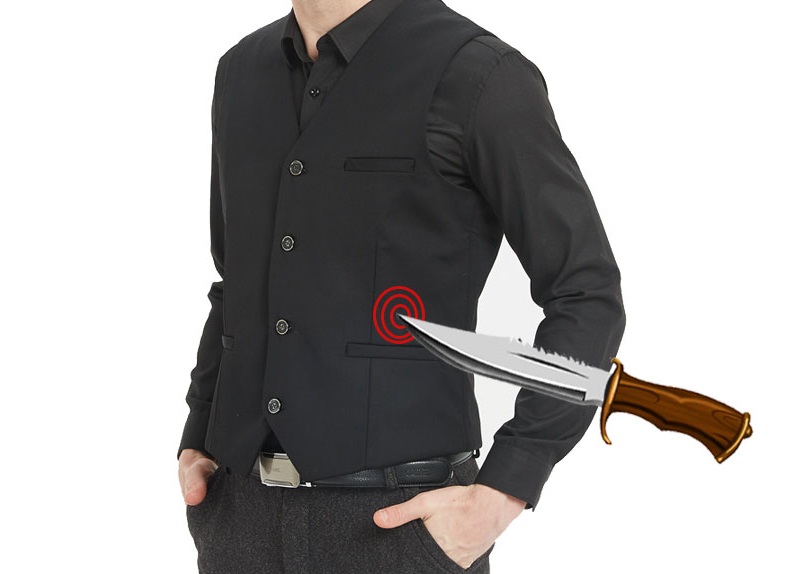
Full Stab proof Waist coast
DEEP DIVE: The Technical Specifications of StabApparel (2026 Edition)
To further understand why StabApparel is the market leader, we need to look at the technical specifications that set their 2026 product line apart. This section is for those who want to understand the “nuts and bolts” of their protection.
1. Molecular Engineering: The UHMWPE Advantage
The UHMWPE used by StabApparel is not just “plastic.” It is a highly engineered polymer with a molecular weight between 3.5 and 7.5 million amu (atomic mass units). This extremely high molecular weight is what allows the long polymer chains to transfer load more effectively to the polymer backbone by strengthening intermolecular interactions.
The “Cross-Ply” Technique:
StabApparel uses a proprietary “cross-ply” construction. Instead of weaving the fibers like a traditional fabric (which creates “gaps” where a needle can pass through), they lay the fibers in parallel sheets. These sheets are then stacked at 0°, 90°, 45°, and 135° angles. This ensures that no matter the angle of the knife strike, the blade is always hitting the maximum number of high-strength fibers.
2. Advanced Energy Dispersion (AED) Technology
One of the biggest innovations in the 2026 StabApparel range is their Advanced Energy Dispersion (AED) layer. This is a semi-flexible, high-density composite layer that sits behind the UHMWPE panels.
How AED Works:
When a knife hits the garment, the UHMWPE stops the blade. However, the energy of that strike is still concentrated in a very small area. The AED layer acts like a “shock absorber,” instantly spreading that energy across the entire surface area of the protective panel. This reduces the “backface signature” (the depth of the dent into the body) by up to 40% compared to traditional soft armour. This is the difference between a minor bruise and a broken rib.
3. The “Stealth-Fit” Ergonomic System
StabApparel’s 2026 t-shirts feature the Stealth-Fit system. This involves:
•Tapered Panels: The protective panels are thinner at the edges, which prevents “printing” (the outline of the armour showing through your shirt).
•Active-Stretch Zones: The areas around the armpits and waist are made from a high-stretch, non-protective fabric. This allows for a full range of motion while ensuring the protective panels stay perfectly positioned over your vital organs.
•Contoured Chest Plates: Unlike flat vests, StabApparel’s panels are pre-curved to follow the natural shape of the human torso, providing a much more natural and comfortable fit.
ADDITIONAL FAQs: Expert Advice for 2026
10. How do I choose the right size for my stab-proof t-shirt?
Sizing is critical for both comfort and safety. A stab-proof t-shirt should fit snugly but not be uncomfortably tight.
•Too Loose: The protective panels may shift during movement, leaving vital areas exposed.
•Too Tight: It will restrict your breathing and make you overheat quickly.We recommend measuring your chest at its widest point and following the StabApparel sizing guide exactly. If you are between sizes, it is usually better to size up for comfort, as the “Stealth-Fit” system will still keep the panels in place.
11. Can I wear my stab-proof hoodie while driving or cycling?
Yes. In fact, many delivery drivers and commuters do exactly this. The flexibility of the UHMWPE panels allows you to sit comfortably in a car seat or lean forward on a bike without the armour “riding up” into your throat. The added weight of the hoodie is also less noticeable when you are in a seated position.
12. What happens if my garment is actually “hit” by a knife?
If your stab-proof clothing is involved in an incident where it successfully stops a blade or spike, it must be replaced immediately. Even if the garment looks fine on the outside, the internal fibers have been stressed and potentially damaged by the impact. Most reputable brands, including StabApparel, offer an “Incident Replacement Program” where they will replace your garment at a significant discount (or even for free) if you provide a police report of the incident.
13. Is the material “stab-proof” against serrated blades?
Yes. Serrated blades (like bread knives or some tactical knives) are designed to “saw” through material. The high-density UHMWPE weave used by StabApparel is extremely resistant to this sawing action. The fibers are so strong and tightly packed that the serrations cannot “bite” into the material effectively, causing the blade to slide off or get stuck without penetrating.
14. Can I wear it through airport security?
While it is legal to own and wear stab-proof clothing, wearing it through an airport metal detector or body scanner will likely trigger an alarm and lead to a secondary search. The high-density panels will show up on a body scanner as a “solid object.” We recommend packing your protective gear in your checked luggage when traveling by air to avoid delays and unnecessary questioning.
THE FUTURE OF PROTECTION: What to Expect Beyond 2026
As we look toward the late 2020s, the technology behind personal safety continues to advance at a rapid pace. StabApparel is already at the forefront of several “next-generation” developments:
1.Smart-Fabric Integration: Future garments may include sensors that can detect an impact and automatically alert emergency services or loved ones with your GPS location.
2.Graphene-Enhanced Fibers: The integration of graphene into UHMWPE could lead to even thinner and stronger protection, potentially creating a “stab-proof” shirt that is no thicker than a standard cotton tee.
3.Advanced Climate Control: New “phase-change materials” (PCMs) are being developed that can actively absorb and release heat, making stab-proof clothing comfortable even in extreme summer temperatures.
By choosing StabApparel today, you are aligning yourself with a brand that is not just reacting to the threats of 2026, but is actively engineering the safety solutions of the future.
The 2026 Safety Checklist
To wrap up this ultimate guide, we’ve created a simple checklist to help you make the best decision for your personal safety. If you can check off all these points, you are well on your way to being properly protected.
1.[ ] Identify Your Risk Level: Are you an everyday commuter, a high-risk professional, or a concerned parent?
2.[ ] Choose Your Style: Do you need a discreet t-shirt, a versatile hoodie, or a professional-grade vest?
3.[ ] Verify Certification: Does the garment meet NIJ 0115.00 or Home Office KR1/KR2 standards?
4.[ ] Check the Material: Is it made from high-grade UHMWPE for maximum strength and minimum weight?
5.[ ] Measure Correctly: Have you followed the sizing guide to ensure a snug, protective fit?
6.[ ] Plan for Maintenance: Do you know how to hand-wash and air-dry your protective gear?
7.[ ] Claim Your Tax Relief: If you’re using it for work, have you kept your receipt for HMRC?
8.[ ] Choose a Specialist: Are you buying from a trusted leader like StabApparel?
A Final Word from the Experts
In the world of personal safety, there is no such thing as “too much” preparation. The threats we face in 2026 are real, but they are not insurmountable. By educating yourself, choosing the right equipment, and staying vigilant, you can significantly reduce your risk and live your life with confidence.
Remember, the best protection is the one you actually wear. Don’t let a bulky, uncomfortable vest sit in your wardrobe. Choose a StabApparel t-shirt or hoodie that integrates seamlessly into your life. It’s a small investment that could one day be the most important decision you ever make.
Stay safe, stay informed, and protect yourself before you need it.