Protective Company Uniforms: Discreet Workforce Protection for UK Businesses
Corporate Protective Uniforms: Everyday Protection for Frontline Workers | STABPROTECT™
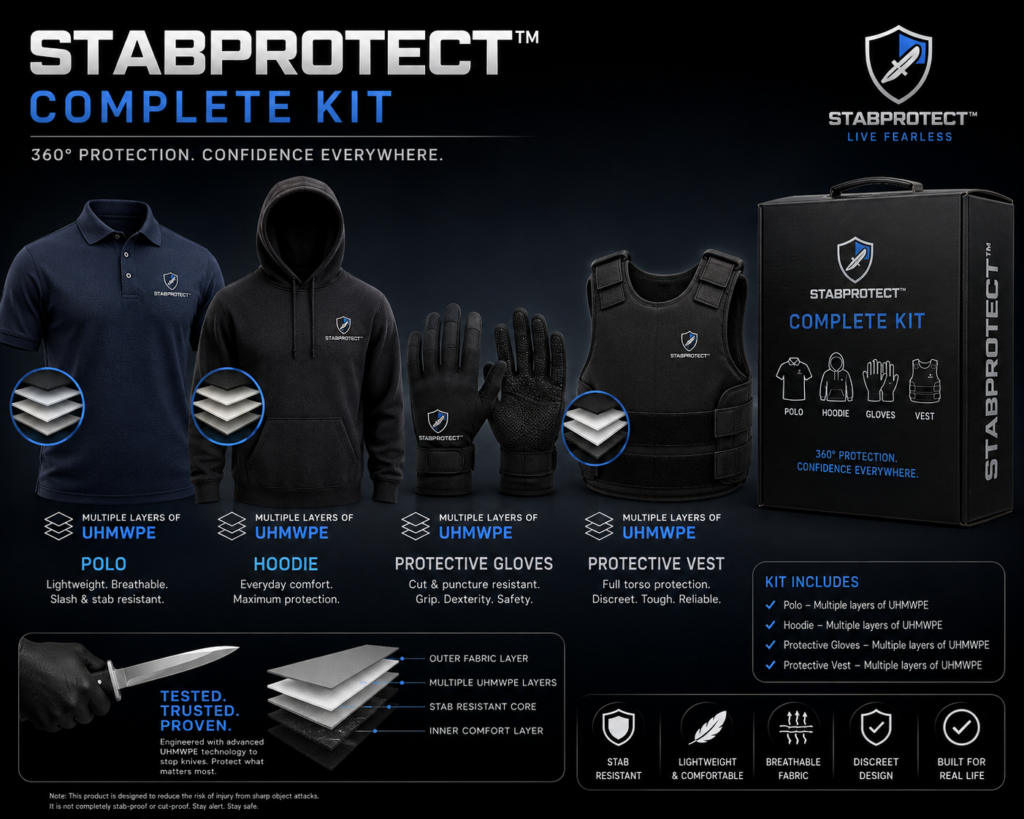
Stabprotect complete Kit
Protect your entire workforce with discreet protective uniforms: Introduction
The way we think about workforce protection especially in United Kingdom is changing.
For decades, protective clothing has been associated with specific, high-risk occupations. Police officers. Security personnel in hostile environments. Military personnel. Construction workers wearing hard hats and high-visibility vests. The protective equipment was visible, functional and unmistakably practical. It looked like protection because it was protection.
But what about everyone else?
Consider the security officer working a corporate reception desk. The door supervisor managing entry to a licensed venue. The retail loss-prevention team member who may need to intervene during a shoplifting incident. The delivery driver who spends hours alone on the road, interacting with members of the public in unpredictable situations. The hospital security contractor moving through busy A&E departments. The housing officer visiting tenants in challenging circumstances. The transport worker dealing with disruptive passengers.
These are not police officers. They are not military personnel. They do not typically wear tactical vests or carry defensive equipment. Yet they may encounter aggression, confrontation and even violence as part of their everyday work.
The Health and Safety Executive has consistently highlighted the risks faced by workers who deal with the public. According to HSE data, workers in public-facing roles are disproportionately affected by work-related violence and aggression, with security, retail, healthcare and transport sectors reporting significant numbers of incidents each year.
The question that arises is this: should protection always look like protection? Or could protective equipment become part of a normal professional uniform—discreet, comfortable and fully integrated into the corporate identity?
This is the central proposition behind discreet protective uniforms, and specifically the STABPROTECT™ Everyday Protection Uniform concept.
STABPROTECT™ represents a proposed evolution in workforce protection. Rather than selling individual protective garments, the vision is to create complete uniform systems that combine discreet protection, professional appearance, corporate branding, employee comfort, procurement efficiency and ongoing support services.
The commercial proposition is not about selling clothing. It is about helping organisations protect their people, standardise their uniforms, manage their workforce clothing and replenish their protective equipment through one professional programme.
This article explores why discreet protection matters, how protective uniforms can be incorporated into everyday workwear without making employees look tactical or intimidating, and what organisations should consider when evaluating workforce protection programmes.
Whether you are a security-company director, a procurement manager, a health and safety professional or a business owner, this guide will help you understand the practical, commercial and operational implications of integrating discreet protection into your workforce uniform strategy.
SECTION 1 — INTRODUCTION: THE SHIFT TOWARDS PROPORTIONATE PROTECTION
The Changing Expectations of Workforce Safety
UK Workplace safety has evolved significantly over the past generation. Once focused primarily on physical hazards in industrial environments, the scope of health and safety now encompasses psychological wellbeing, lone working, public-facing risks and the complex challenges of modern service-sector employment.
Organisations have legal obligations under the Health and Safety at Work etc. Act 1974 and the Management of Health and Safety at Work Regulations 1999 to assess risks to employees and implement appropriate control measures. These obligations extend to risks arising from violence, aggression and confrontation in the workplace.[citation:9]
The Health and Safety Executive defines work-related violence as “any incident in which a person is abused, threatened or assaulted in circumstances relating to their work”. This definition encompasses everything from verbal abuse and threats to physical assault. The HSE estimates that hundreds of thousands of workers experience work-related violence each year, with the true figure likely higher due to under-reporting.
The sectors most affected include security, retail, healthcare, education, transport and public services. In these environments, workers are routinely exposed to members of the public who may be stressed, under the influence of alcohol or drugs, experiencing mental health difficulties or simply inclined towards aggressive behaviour.
Protection That Doesn’t Look Like Protection
Traditionally, protective equipment has been designed to be visible. High-visibility clothing alerts others to the wearer’s presence. Hard hats signal that the environment is hazardous. Tactical vests and body armour are unmistakably protective in appearance.
This visibility serves an important purpose. It communicates that the wearer is prepared for risk. It can act as a deterrent. It signals to others that the environment or role requires protection.
However, visibility is not always desirable.
Consider a hotel security manager who needs to maintain a welcoming, professional appearance while remaining prepared to handle confrontations. A corporate receptionist who must greet visitors with warmth and professionalism, yet works in a building where security incidents have occurred. A door supervisor who needs to be authoritative without appearing aggressive or intimidating.
In these contexts, visible protective equipment can be counterproductive. It can create unnecessary anxiety among customers or clients. It can make employees feel conspicuous. It can undermine the professional image that organisations work hard to cultivate.
The alternative is discreet protection: protective clothing designed to look like normal professional workwear, with protective components integrated invisibly into the garment construction.
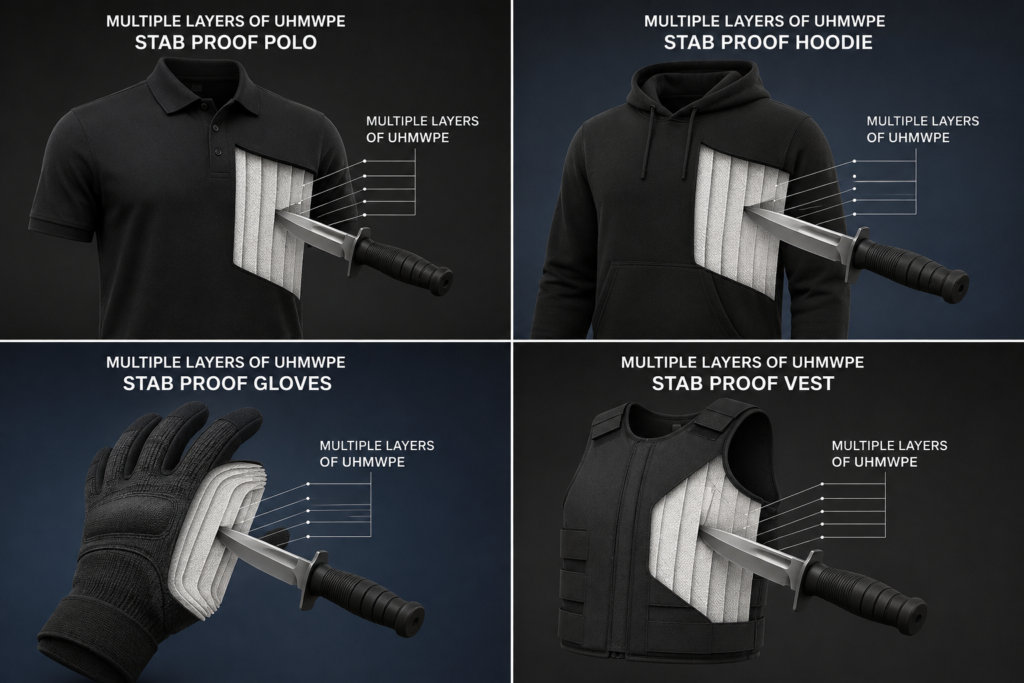
The STABPROTECT™ Proposition
STABPROTECT™ Everyday Protection Uniform is a proposed product family designed to provide discreet protective clothing for professional workforces.
The concept is straightforward: create normal-looking workplace uniforms—polo shirts, T-shirts, hoodies and jackets—that incorporate protective layers designed to provide resistance against sharp objects and other threats.
The garments are intended to look like regular corporate uniforms. The protective elements are concealed within the construction. Employees can wear the clothing throughout their working day without looking tactical, militarised or intimidating.
The commercial vision extends beyond individual garments. STABPROTECT™ aims to become a complete workforce protection system, offering:
- Protective uniforms for various roles and environments
- Corporate branding and customisation
- Employee fitting and size management
- Bulk procurement and managed inventory
- Replacement and renewal programmes
- Ongoing support and guidance
This article examines the full proposition, from the product range and target markets to the commercial models and implementation considerations.
SECTION 2 — THE CHANGING FACE OF WORKPLACE RISK
Beyond Traditional High-Risk Occupations
When most people think about workplace protection, they picture specific high-risk environments. Construction sites. Factories. Chemical plants. Offshore oil rigs. These are environments where physical hazards are visible, well-understood and managed through established safety protocols.
But the reality of modern workplace risk is far more diverse.
Public-Facing Roles
Millions of UK workers spend their working days interacting with the public. These interactions are usually positive, professional and uneventful. However, the same interactions can sometimes escalate into confrontation, aggression or violence.
Lone Working
Lone workers are particularly vulnerable. The HSE defines lone workers as those who work by themselves without close or direct supervision. This includes delivery drivers, security officers on solo patrols, taxi drivers, estate agents, housing officers and many others.
The risk to lone workers is elevated because there is no immediate backup. If an incident occurs, assistance may not be readily available.
Mobile Workers
Mobile workers—those who travel between locations as part of their job—face additional risks. They may be unfamiliar with the areas they are visiting. They may not have access to workplace support systems while on the road. They may spend significant time in their vehicles, which can become environments where confrontation occurs.
Customer-Facing Staff
Retail workers, hospitality staff, receptionists and other customer-facing employees interact with large numbers of people every day. Most interactions are routine, but some involve difficult customers, complaints, disputes or aggressive behaviour.
The British Retail Consortium has documented rising levels of abuse and violence against retail workers. Similar challenges exist in hospitality, leisure and other service sectors.
The Legal Framework for Risk Assessment
Employers have a legal duty to assess risks to employee health and safety. The Management of Health and Safety at Work Regulations 1999 require employers to make “suitable and sufficient” assessments of the risks to which employees are exposed.
Where risks of violence or aggression are identified, employers must take reasonably practicable steps to control those risks. This may include:
- Implementing policies and procedures
- Providing training
- Modifying the working environment
- Offering support
- Providing personal protective equipment (PPE)
Protective uniforms may form part of this broader risk-control strategy.
The Hierarchy of Controls
Health and safety professionals follow a hierarchy of controls when managing workplace risks:
- Elimination: Remove the hazard entirely.
- Substitution: Replace the hazard with something less dangerous.
- Engineering controls: Physical modifications to reduce risk.
- Administrative controls: Policies, training and procedures.
- PPE: Personal protective equipment.
Protective clothing is at the bottom of this hierarchy. It is a last line of defence, not a substitute for more effective controls.
This is an important point. Organisations should not rely on protective uniforms to address risks that could be better managed through training, policy changes, environmental modifications or proper staffing.
Protective uniforms should be considered one component of a comprehensive safety strategy, alongside training, risk assessment, incident reporting, CCTV, access control and emergency procedures.
The Role of Protective Clothing in Risk Control
When other controls are in place but residual risk remains, personal protective equipment may be appropriate. Protective uniforms can provide an additional layer of defence in situations where employees may face physical threats.
The key is that protective clothing should be proportionate to the risk. Not every worker requires protection. Not every environment warrants protective garments. The decision to deploy protective uniforms should follow a thorough risk assessment.
SECTION 3 — WHY DISCREET PROTECTION MATTERS
The Psychology of Appearance
The way we dress affects how others perceive us. Uniforms signal authority, professionalism, competence and legitimacy. They also signal affiliation and create a sense of identity.
This is why uniforms are used across so many professions—from police officers and healthcare workers to pilots and security guards. The uniform conveys information about the wearer’s role and status.
The same principle applies to protective clothing. Tactical-style protective equipment communicates that the wearer is prepared for conflict. This can be appropriate in certain contexts but may be problematic in others.
Benefits of Discreet Protection
Professional Appearance
A discreet protective uniform looks like a professional corporate uniform. Employees maintain a polished appearance that reflects positively on the organisation.
Reduced Visual Intimidation
Visible tactical equipment can appear intimidating to the public. This may be undesirable in customer-facing environments where staff need to appear approachable.
Uniform Consistency
Employees can wear protective uniforms as their normal workwear, rather than switching between different garments depending on the perceived risk level.
Corporate Branding
Discreet protective garments provide a canvas for corporate branding. Logos, colours and employee identification can be incorporated just as they would be on standard uniform items.
Employee Acceptance
Employees may be more willing to wear protective clothing that looks like normal workwear. This can help ensure that protective measures are actually used.
Trade-Offs and Limitations
Discreet protection involves trade-offs. Protective materials may add weight and reduce flexibility. They may affect breathability and comfort, particularly in warm environments. Laundering requirements may be more demanding than for standard clothing.
These practical considerations must be addressed through careful product design. The goal should be a garment that employees are willing and able to wear throughout the working day.
SECTION 4 — INTRODUCING STABPROTECT™ EVERYDAY PROTECTION UNIFORM
A Complete Uniform System
The STABPROTECT™ proposition is built around a range of garments designed for different roles, environments and seasons.
The range is deliberately structured around normal workplace clothing. Polo shirts, T-shirts, hoodies and jackets are familiar garments that employees already wear. By incorporating protective layers into these familiar forms, the technology becomes accessible and practical.
The product family consists of five proposed offerings:
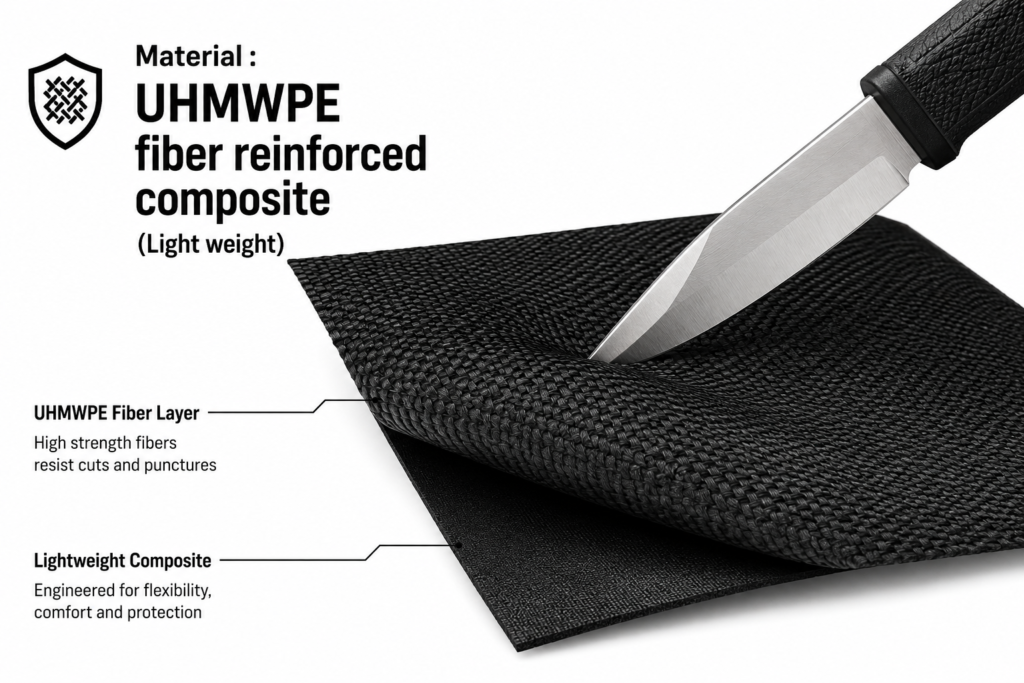
Stabproof clothing saintfabirc UHMWPE fiber
Product Overview
| Product | Intended Role | Indicative Target Price (per unit) | Potential Users |
|---|---|---|---|
| Protective Polo | Everyday corporate uniform | £199–£299 | Security staff, retail teams, door supervisors, corporate security |
| Protective T-shirt | Under-uniform protection | £179–£249 | Existing uniform wearers, layered protection |
| Protective Hoodie | Outdoor and mobile workers | £249–£349 | Delivery drivers, transport workers, event security, field teams |
| Protective Jacket | Premium outerwear | £399–£599 | Outdoor security, transport, infrastructure, winter operations |
| Complete Kit | Full protection package | £499–£699+ | New employees, high-risk roles, complete uniform provisioning |
Bulk Discount is available for Business
SECTION 5 — STABPROTECT™ POLO: THE EVERYDAY CORE GARMENT
A Professional Foundation
The polo shirt is a staple of corporate uniforms. It is comfortable, professional and versatile. It can be branded with logos, worn in various environments and easily combined with other uniform items.
A protective polo offers the same benefits while incorporating a discreet protective layer.
Intended Users
Security officers working in corporate environments, retail premises, events or hospitality settings may find the protective polo particularly suitable. Door supervisors, loss-prevention staff and frontline security personnel could benefit from everyday protection that does not compromise their professional appearance.
Key Considerations
Fit and Comfort
A protective polo must fit well to be effective. It must also be comfortable enough to wear throughout a shift. These requirements can be challenging to combine with protective materials.
Breathability
Employees may wear polo shirts in warm environments. If the protective layer affects breathability, comfort will suffer. Addressing this requires careful material selection and garment design.
Corporate Identity
Polo shirts can be embroidered or printed with corporate logos, employee names, department identifiers or other branding. The protective layer should not interfere with branding opportunities.
Replacement Availability
Employees may require replacement garments due to wear, damage or changes in size. A robust uniform programme must include replacement supply.
SECTION 6 — STABPROTECT™ T-SHIRT: UNDER-UNIFORM PROTECTION
An Invisible Layer
Many organisations already have established uniforms. Employees may wear branded shirts, high-visibility workwear, corporate jackets or other garments.
A protective T-shirt can be worn underneath these existing uniform items, providing protection without requiring changes to the visible uniform.
Scenarios
Existing Branded Shirts
If an organisation has invested in branded shirts, a protective T-shirt can be worn beneath them. The visible uniform remains unchanged while the employee gains protection.
High-Visibility Workwear
High-visibility vests or jackets can be worn over a protective T-shirt. The protective layer is concealed beneath the high-visibility garment.
Layered Protection
A protective T-shirt can be layered with other protective garments to provide comprehensive coverage.
Seasonal Flexibility
A T-shirt is suitable for warmer months. In cooler weather, it can be worn under jackets or hoodies.
SECTION 7 — STABPROTECT™ HOODIE: OUTDOOR AND MOBILE WORKERS
Practical Protection for Mobile Roles
Hoodies are practical garments for outdoor and mobile workers. They provide warmth, have pockets and hoods for weather protection and are comfortable to wear during physical activity.
A protective hoodie incorporates these practical features while adding a discreet protective layer.
Intended Users
Security personnel working outdoors or in unheated environments may find a protective hoodie valuable. Delivery drivers, transport workers, event security, infrastructure workers and field teams are all potential users.
Practical Considerations
Weather and Layering
Hoodies are typically mid-layer garments. They can be worn under jackets or over T-shirts, allowing employees to adapt to changing weather conditions.
Movement and Flexibility
Mobile workers often need freedom of movement. The protective layer should not restrict movement or impede physical activity.
Visibility
For roles requiring high visibility, the hoodie may need to be worn under or over high-visibility garments.
Laundering
Hoodies are frequently laundered. The protective layer must withstand repeated washing while maintaining its protective properties.
SECTION 8 — STABPROTECT™ JACKET: PREMIUM OUTERWEAR
Protection in All Weather
A protective jacket represents the premium offering in the STABPROTECT™ range. It provides protection and weather resistance in a professional outer garment.
Intended Users
Outdoor security personnel, transport workers, infrastructure staff, event security and corporate security teams are potential users. Jackets may also be suitable for senior or management team members who require protection while maintaining a professional appearance.
Commercial Considerations
Premium Positioning
The jacket is positioned as the highest-cost item in the range. This reflects its additional functionality and the more complex garment design.
Seasonal Demand
Jackets may be subject to seasonal demand, with most orders placed before autumn and winter. Organisations should plan procurement around seasonal needs.
Corporate Identity
Jackets provide a large canvas for corporate branding. They can carry company logos, employee names, department identifiers and other branding elements.
SECTION 9 — STABPROTECT™ COMPLETE KIT: COMPREHENSIVE PROTECTION
Simplifying Procurement
Rather than purchasing individual protective garments, organisations may prefer to purchase complete kits.
A complete kit could include:
- Protective polo shirt
- Protective hoodie
- Protective gloves
- Protective vest
The kit approach simplifies procurement by providing everything needed in a single package.
Benefits
One Supplier
A single supplier can provide all protective clothing requirements, simplifying procurement and reducing administrative burden.
Standardised Protection
All employees receive consistent protection when they are issued with the same kit.
Simplified Replacement
When employees need replacement garments, they can be issued from the same supply chain.
Employee Onboarding
New employees can be issued with a complete kit immediately, ensuring they are protected from day one.
Different Kits for Different Roles
Different roles may require different combinations of protective garments. An office-based employee may only need a protective polo, while a frontline security officer may require the full kit.
SECTION 10 — FROM CLOTHING TO WORKFORCE PROTECTION SYSTEM
Product Thinking vs System Thinking
Most uniform suppliers sell individual garments. A customer orders shirts, the shirts are delivered and the transaction ends.
A system-thinking approach is different. It considers the entire lifecycle of the uniform programme:
- Garment design
- Procurement
- Customisation
- Fitting
- Replacement
- Renewal
- Support
Components of a Workforce Protection System
Garments
The physical products—protective uniforms designed for specific roles and environments.
Protective Components
The protective layers integrated into the garments.
Corporate Branding
Logos, colours, employee identification and other branding elements.
Employee Fitting
Ensuring that each employee receives properly fitting garments.
Size Management
Managing inventory across different sizes and replacing garments as employees change size.
Replacement
Providing replacement garments when existing garments are worn, damaged or outgrown.
Renewal
Refreshing the uniform programme at intervals.
Inventory Management
Managing stock to ensure garments are available when needed.
Procurement
The purchase process, including tendering, contracting and ongoing supply management.
Training and Guidance
Supporting employees in using and caring for protective uniforms.
The Protective Uniform Supplier as Partner
A system-focused supplier becomes a workforce protection partner, not just a clothing supplier. The relationship is ongoing, with continuous support, replenishment and programme management.
SECTION 11 — CORPORATE UNIFORM CUSTOMISATION
Making It Yours
A protective uniform should look like a legitimate corporate uniform, not generic tactical equipment. Customisation is essential.
Customisation Options
Embroidered Logos
Logos can be embroidered onto garments using corporate colours and design standards.
Printed Logos
Printing may be suitable for some garments or design elements.
Company Colours
Garments can be produced in corporate colours, reinforcing brand identity.
Staff Identification
Employee names, roles or departments can be displayed on garments.
Bespoke Configurations
Organisations may require specific garment configurations, such as additional pockets, specific closures or particular design features.
Balancing Branding and Protection
Branding must be applied in a way that does not compromise the protective function of the garment. The protective layer should not be affected by embroidery or printing. The branding process should not create weak points in the garment construction.
SECTION 12 — BULK ORDERS
Ordering at Scale
Large organisations may need to procure protective uniforms in significant volumes.
Example Order Sizes
- 10 employees
- 25 employees
- 50 employees
- 100 employees
- 250 employees
- 500+ employees
Procurement Considerations
Minimum Order Quantities
Most suppliers have minimum order quantities that must be met.
Size Runs
Orders must include all required sizes. The correct size distribution should be determined based on employee requirements.
Sampling
Before placing a large order, organisations should consider sampling garments to ensure they meet expectations.
Pilot Programmes
A controlled pilot with a smaller group can help identify issues before full rollout.
Employee Fitting
Employees should be measured to ensure accurate sizing.
Corporate Approvals
Multiple stakeholders may need to approve the order, including procurement, operations, health and safety and senior management.
Delivery Schedules
Large orders may be delivered in phases rather than all at once.
Replacement Stock
Organisations should maintain replacement stock for new employees and for employees who need replacements.
Seasonal Demand
Orders should be planned around seasonal needs.
SECTION 13 — CORPORATE PROCUREMENT
What Procurement Professionals Need to Know
Procurement managers evaluate suppliers against multiple criteria. To be considered, a protective uniform supplier must provide comprehensive information.
Information Requirements
Product Specifications
Detailed information about garment construction, materials and protective properties.
Testing Evidence
Evidence of independent testing demonstrating protection.
Certification
Certification to relevant standards (subject to verification).
Warranty
Warranty terms and conditions.
Lead Times
How long between order placement and delivery.
Minimum Order Quantities
The minimum number of garments per order.
Pricing
Complete pricing information for all product options.
Volume Pricing
How pricing changes with volume.
Product Lifecycle
How long products will be available.
Replacement Policy
How replacements are handled.
Supplier Stability
The supplier’s financial stability and ability to continue operations.
Insurance
Insurance coverage held by the supplier.
Data Protection
How employee data is handled and protected.
Returns
Return policy and procedures.
Sizing
Size range and fitting guidance.
Laundry Requirements
Care instructions and laundry considerations.
Sustainability
Environmental and sustainability credentials.
Packaging
Packaging and waste considerations.
Supplier Onboarding
The process for becoming a supplier.
Contract Terms
Contractual terms and conditions.
Service Levels
Service level agreements covering delivery times, replacement speed and support.
SECTION 14 — PILOT PROGRAMMES
Testing Before Commitment
Most B2B buyers are unlikely to equip an entire workforce without testing.
A Practical Pilot Model
Phase 1 — Discovery
Risk assessment and workforce analysis. Understand the specific risks employees face.
Phase 2 — Sampling
Obtain selected garments in appropriate sizes.
Phase 3 — Employee Fitting
Fit selected employees with garments and gather initial feedback.
Phase 4 — Field Trial
Deploy garments in a controlled environment or limited area.
Phase 5 — Review
Gather feedback on comfort, usability, appearance, durability and operational suitability.
Phase 6 — Rollout
Following a successful pilot, deploy organisation-wide.
Pilot Programme Benefits
A pilot programme can identify issues before they affect the entire workforce. It provides evidence for decision-making. It can build employee buy-in by involving employees in testing.
SECTION 15 — SECURITY COMPANIES
A Natural Market
Security companies are the primary target market for protective uniforms. Employees face well-documented risks of confrontation, aggression and violence.
Potential Applications
Static Guarding
Security officers at fixed locations may benefit from everyday protection.
Mobile Patrols
Patrol officers may encounter unpredictable situations.
Retail Security
Retail security teams face specific risks.
Events
Event security may need protection during large gatherings.
Door Supervision
Door supervisors face aggression from customers.
Corporate Security
Security in corporate environments may benefit from discreet protection.
Commercial Proposition
For security companies, protective uniforms can become part of the employee value proposition and the client offering. A company that protects its people is more attractive to clients and employees.
SECTION 16 — DOOR SUPERVISORS AND THE NIGHT-TIME ECONOMY
High-Risk Environments
Clubs, bars, pubs and other night-time economy venues are high-risk environments. Door supervisors regularly deal with intoxicated individuals, disputes and confrontations.
The Need for Discreet Protection
Door supervisors need to appear authoritative but not aggressive. A discreet protective uniform allows them to maintain a professional appearance while being protected.
Employee Acceptance
Door supervisors may resist overtly tactical clothing. Discreet protection is more likely to be accepted and worn consistently.
SECTION 17 — RETAIL SECURITY
Rising Challenges
Retail workers and security teams face increasing levels of abuse and violence. Shoplifting incidents can escalate into confrontation.
Protection in Customer-Facing Roles
Retail security personnel interact with customers while performing enforcement functions. A protective uniform can provide reassurance to employees while maintaining a professional appearance.
SECTION 18 — TRANSPORT, DELIVERY AND LOGISTICS
Mobile Workers
Delivery drivers and transport personnel are often lone workers who spend significant time away from controlled environments.
Risks for Mobile Workers
- Confrontation with customers
- Vehicle-related incidents
- Theft attempts
- Aggression in public spaces
Protective Uniforms for Mobile Workers
A protective hoodie or jacket can provide everyday protection for mobile workers. Garments should be suitable for driving, comfortable in various weather conditions and capable of being worn for extended periods.
SECTION 19 — TAXI AND PRIVATE-HIRE OPERATORS
Lone Working
Taxi drivers are lone workers who may encounter aggressive or intoxicated passengers.
Fleet Programmes
Private-hire companies with large fleets could procure protective uniforms for their drivers. This could form part of a wider driver-safety strategy.
SECTION 20 — HEALTHCARE AND MENTAL-HEALTH TRANSPORT
A Sensitive Context
Healthcare environments, including hospital security, patient transport and mental-health transport, present specific challenges.
Balancing Protection and Safeguarding
Protective uniforms in healthcare settings must be deployed sensitively. The focus should be on de-escalation, training, risk assessment and safeguarding. Protective clothing should be positioned as one potential layer of a wider safety programme, not as a substitute for proper patient management.
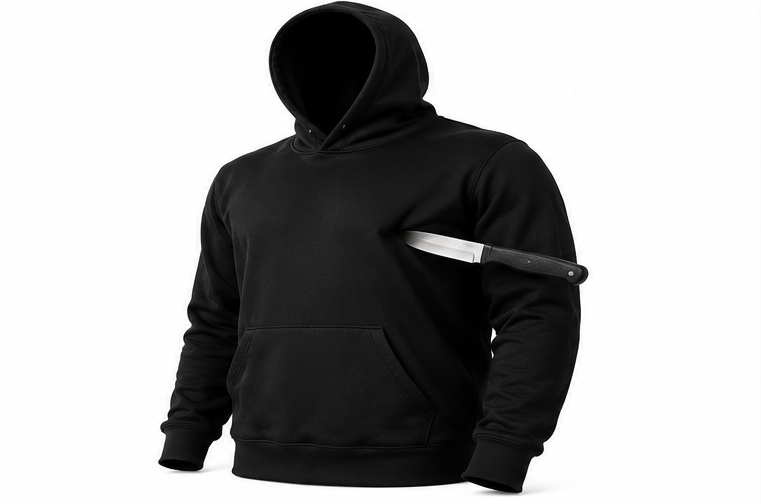
UHMWPE protective materials hoodie
SECTION 21 — LOCAL AUTHORITIES
Public-Sector Applications
Local authority workers, including housing officers, enforcement teams and environmental staff, interact with the public and may face confrontation.
Public-Sector Procurement
Local authority procurement is subject to specific rules, including:
- Tendering requirements
- Framework agreements
- Social value considerations
- Sustainability requirements
SECTION 22 — EVENTS AND VENUES
Temporary Workforces
Events involve temporary staff who may need protective uniforms for short-term deployments.
Rental and Managed Inventory
For events, rental, managed inventory or event-specific procurement models could be developed.
SECTION 23 — UNIVERSITIES, SCHOOLS AND COLLEGES
Campus Security
Campus security personnel, estates teams and front-of-house staff may benefit from protective uniforms.
Safeguarding Considerations
Safeguarding is a priority in educational settings. Protective uniforms must be deployed in a way that supports safeguarding objectives and avoids unnecessary intimidation.
SECTION 24 — CONSTRUCTION AND INFRASTRUCTURE
Site Personnel
Construction personnel, utilities workers, rail staff and highways workers may encounter confrontation from members of the public.
Integration with Existing PPE
Protective uniforms do not replace mandatory PPE or site-specific requirements. They should be worn in addition to required equipment.
SECTION 25 — FRONTLINE PUBLIC-FACING WORKERS
Broadening the Concept
The market for discreet protective uniforms extends beyond traditional security roles. Any employee who routinely interacts with the public may be a candidate.
Potential Roles
- Housing officers
- Enforcement teams
- Customer complaints teams
- Late-night transport staff
- Environmental teams
- Inspection teams
SECTION 26 — EMPLOYEE ACCEPTANCE
A Critical Factor
No protective uniform programme will succeed if employees refuse to wear the garments.
Factors Affecting Acceptance
Comfort
If garments are uncomfortable, employees will avoid wearing them.
Appearance
If garments look unattractive or unprofessional, employees may object.
Fit
Garments must fit properly.
Heat
Protective materials may affect heat dissipation.
Mobility
Employees need freedom of movement.
Weight
Excessive weight causes fatigue.
Confidence
Garments should enhance confidence, not undermine it.
Stigma
Employees may not want to be seen as needing protection.
Practicality
Garments should support the employee’s ability to do their job.
Involving Employees in Testing
Involving employees in testing and procurement decisions can improve acceptance. When employees feel their views are respected, they are more likely to support the programme.
SECTION 27 — SIZING AND FITTING
Complexity with Protection
Sizing becomes significantly more complex when protective components are incorporated into garments.
Key Considerations
Male and Female Fits
Garments must accommodate different body shapes.
Different Body Shapes
Employees come in various shapes and sizes.
Size Availability
A wide range of sizes should be available.
Individual Fitting
Each employee should be measured individually.
Remote Sizing
Guidance for remote fitting may be needed.
Exchanges
Employees may need to exchange garments for different sizes.
New Starters
New employees need to be fitted quickly.
Employee Turnover
High turnover requires efficient fitting processes.
SECTION 28 — LAUNDERING AND MAINTENANCE
Caring for Protective Uniforms
Protective uniforms require specific care to maintain their protective properties.
Key Considerations
Washing Instructions
Garments must be washed correctly to avoid damaging the protective layer.
Drying
Drying methods may affect garment performance.
Garment Longevity
Protective garments may have a defined lifespan.
Damage Inspection
Employees should inspect garments for damage.
Replacement
Damaged garments should be replaced.
Storage
Garments should be stored appropriately.
Professional Laundry Services
Some organisations may use professional laundry services for protective uniforms.
SECTION 29 — TESTING, CERTIFICATION AND QUALITY ASSURANCE
Building Credibility
Protective clothing claims must be supported by evidence.
Key Considerations
Laboratory Testing
Garments should be tested in appropriate laboratories.
Independent Validation
Testing should be performed by independent bodies.
Relevant Standards
Testing should be conducted against relevant standards.
Product Documentation
Comprehensive documentation should be maintained.
Traceability
Products should be traceable back to manufacturing.
Quality Control
Manufacturing controls must be in place.
Batch Consistency
Products should be consistent between batches.
Product Labelling
Labels should provide clear information.
Instructions for Use
Employees should receive clear instructions.
Warranty Limitations
Warranties should be clear about exclusions.
SECTION 30 — UK REGULATORY AND PROCUREMENT CONSIDERATIONS
Understanding the UK Market
The UK has specific regulatory requirements and procurement practices.
PPE Requirements
Under UK law, personal protective equipment is subject to specific requirements. PPE must be properly designed, manufactured and supplied with appropriate documentation.
Product Conformity
Products must meet applicable conformity requirements before being placed on the market.
Employer Responsibilities
Employers have obligations under health and safety legislation to provide appropriate protection.
Risk Assessment
Risk assessment is the foundation of protection decisions.
SECTION 31 — CORPORATE BRANDING
Professional Identity
A protective uniform should carry the organisation’s branding.
Logos
Corporate logos can be embroidered or printed.
Company Name
The company name can appear on garments.
Employee Name
Names can be displayed for identification.
Department and Role
Department or role identifiers can be displayed.
Identification
Employee identification can be integrated.
Corporate Colours
Garments can match corporate colours.
SECTION 32 — THE PROCUREMENT JOURNEY
A Practical Buyer Journey
1. Identify Workforce Risk
Assess risks to employees and determine whether protective uniforms are appropriate.
2. Define Requirements
Specify what is needed: product types, quantities, customisation.
3. Contact Supplier
Approach potential suppliers with requirements.
4. Product Consultation
Discuss options, pricing, lead times and customisation.
5. Sample Garments
Obtain samples to evaluate.
6. Employee Fitting
Fit employees to ensure correct sizing.
7. Pilot
Deploy to a limited group.
8. Evaluate
Review feedback and performance.
9. Approve
Obtain internal approval for full rollout.
10. Purchase
Place the order.
11. Brand/Customise
Apply branding to garments.
12. Deploy
Issue garments to employees.
13. Manage Replacements
Replace damaged or outgrown garments.
14. Review Annually
Conduct annual programme review.
15. Renew or Expand
Renew the programme or expand to new employees.
SECTION 33 — THE WORKFORCE PROTECTION PROGRAMME
Introducing STABAPPAREL
The STABAPPAREL WORKFORCE PROTECTION PROGRAMME is a proposed recurring B2B service.
Illustrative Commercial Model
| Number of Employees | Monthly Cost (Illustrative) | Annual Contract Value (Illustrative) |
|---|---|---|
| 10 employees | £390–£590 | £4,680–£7,080 |
| 50 employees | £1,950–£2,950 | £23,400–£35,400 |
| 100 employees | £3,900–£5,900 | £46,800–£70,800 |
| 250 employees | £9,750–£14,750 | £117,000–£177,000 |
| 500 employees | £19,500–£29,500 | £234,000–£354,000 |
| 1,000 employees | £39,000–£59,000 | £468,000–£708,000 |
These are illustrative examples only and not a commitment to specific pricing.
Potential Programme Benefits
- Protective uniform
- Replacement and renewal programme
- Size exchanges
- Employee fitting
- Corporate branding
- Priority support
- Annual inspection/replacement
- Staff protection guidance
SECTION 34 — WHY SUBSCRIPTION COULD CHANGE THE BUSINESS MODEL
Traditional Model vs Subscription Model
| Aspect | Traditional Model | Workforce Protection Programme |
|---|---|---|
| Transaction | One-off purchase | Ongoing subscription |
| Relationship | Transactional | Long-term partnership |
| Revenue | One-time | Recurring |
| Customer Lifetime Value | Low | High |
| Customer Retention | Limited | Enhanced through service |
Potential Benefits of Recurring Revenue
- Predictable revenue
- Higher customer lifetime value
- Better customer retention
- Easier replacement management
- Regular product upgrades
- Stronger customer relationships
Risks and Challenges
- Service costs
- Replacement liabilities
- Inventory
- Contract management
- Customer churn
- Employee turnover
- Damaged garments
- Misuse
- Cleaning
- Logistics
- Working capital
SECTION 35 — ILLUSTRATIVE B2B ECONOMICS
Conceptual Examples
Small Workforce
50 employees × £49/month = £2,450/month
£2,450 × 12 = £29,400 annual contract value
Large Workforce
250 employees × £49/month = £12,250/month
£12,250 × 12 = £147,000 annual contract value
These calculations are illustrative only and should not be treated as projections without proper financial modelling.
Factors Affecting Profitability
- Customer acquisition costs
- Gross margin
- Fulfilment costs
- Replacement rates
- Employee turnover
- Logistics costs
- Administrative overheads
SECTION 36 — CUSTOMER LIFETIME VALUE
Value Beyond the Initial Sale
A recurring relationship with a customer is more valuable than a one-off transaction.
Revenue Streams
- Initial contract
- Renewal
- Additional employees
- New branches
- Replacement garments
- Seasonal products
- Upgrades
- New product categories
Becoming Embedded
The goal is to become embedded into the customer’s workforce-management process. When the programme is essential to operations, the customer is more likely to renew.

UHMWPE protective materials Knife Proof Anti Cut T-shirt
SECTION 37 — CORPORATE PROCUREMENT PACKAGES
Suggested Package Structures
| Package | What It Includes |
|---|---|
| Essential | Core protective uniform |
| Professional | Multiple garments + branding + fitting |
| Workforce | Full uniform programme + replacements |
| Enterprise | Large-scale procurement + account management + managed inventory + ongoing support |
SECTION 38 — WHY BULK PROCUREMENT MATTERS
Supplier Consolidation Benefits
Organisations prefer to reduce the number of suppliers they manage.
- Fewer suppliers to manage
- Standardised appearance
- Simplified invoicing
- Consistent quality
- Easier replenishment
- Centralised branding
- Easier compliance documentation
- Better workforce consistency
SECTION 39 — THE ROLE OF TECHNOLOGY
Potential Future Capabilities
- Online sizing portals
- Employee allocation
- Procurement dashboards
- Reorder management
- Digital garment records
- Replacement reminders
- Stock visibility
- Corporate ordering portals
SECTION 40 — SUSTAINABILITY
Environmental Considerations
- Garment lifespan
- Repair possibilities
- Recycling
- Packaging
- Reduced over-ordering
- Managed inventory
- Responsible materials
Protective garments have different end-of-life considerations from conventional clothing. The protective components may require specialist disposal or recycling.
SECTION 41 — EMPLOYEE TRAINING AND GUIDANCE
Protecting People, Not Just Clothing
Clothing alone is not a complete safety solution.
Training and Guidance Should Address
- Risk assessment
- De-escalation
- Conflict management
- Incident reporting
- Emergency procedures
- Correct garment use
- Inspection
- Maintenance
SECTION 42 — RISK ASSESSMENT
The Foundation of Protection Decisions
Organisations should consider:
- Who is at risk?
- What hazards exist?
- Where do incidents occur?
- When do incidents occur?
- How frequently?
- What controls already exist?
- What additional measures are appropriate?
Proportionate Protection
Protective clothing is not universally necessary. Decisions should be based on risk assessment.
SECTION 43 — DESIGNING FOR NORMAL WORK
The Best Protective Uniform Is One Employees Will Wear
Key design considerations:
- Familiar silhouettes
- Corporate appearance
- Mobility
- Comfort
- Climate
- Layering
- Professionalism
- Practical pockets
- Durability
- Cleaning
SECTION 44 — THE PSYCHOLOGY OF CONFIDENCE
How Workwear Affects Employees
Appropriate workwear may affect employee confidence and perception. Feeling protected can help employees perform their roles with greater confidence.
Care with Claims
Psychological benefits should be framed as possibilities rather than proven effects. Use language such as “could”, “may”, “potentially”.
SECTION 45 — WHY DISCREET MAY BE BETTER THAN TACTICAL
Tactical-Looking Protection
- Obvious protective function
- May appear intimidating
- Can create public anxiety
- May undermine corporate image
Integrated Professional Protection
- Professional appearance
- Reduced visual intimidation
- Corporate identity
- Employee acceptance
- Everyday usability
- Supports brand image
Different environments require different solutions.
SECTION 46 — THE BUSINESS CASE FOR EMPLOYERS
Decision-Making Framework
Workforce Safety
Protecting employees is a legal and ethical obligation.
Employee Confidence
Protected employees may perform better.
Uniform Standardisation
One programme covers all workforce clothing needs.
Procurement Efficiency
One supplier for all protective uniform requirements.
Staff Retention
Protected employees may be more likely to stay.
Corporate Image
A professional uniform enhances the corporate image.
Long-Term Cost
Managed programmes may be more cost-effective over time.
SECTION 47 — THE BUSINESS CASE FOR SECURITY COMPANIES
Competitive Advantage
Protective uniforms can be used as:
- Employee benefit
- Client differentiator
- Contract feature
- Workforce standard
- Premium service component
The uniform itself becomes part of the company’s competitive proposition.
SECTION 48 — SELLING TO ENTERPRISES
Multiple Stakeholders
- Procurement
- Operations
- Health and safety
- HR
- Finance
- Security
- Legal
- Senior management
- Employees
Multi-Stakeholder Selling
The sales process must address each stakeholder’s concerns.
SECTION 49 — SELLING TO THE PUBLIC SECTOR
Longer Procurement Cycles
- Tendering requirements
- Framework agreements
- Specifications
- Evidence
- Supplier due diligence
- Social value
- Sustainability
- Pricing
- Contract performance
SECTION 50 — THE FUTURE OF WORKFORCE PROTECTION
Convergence
The convergence of:
Uniform + PPE + protective equipment + procurement + service + technology
Evolution
Protective workwear is evolving from a commodity into a managed corporate service.
SECTION 51 — FROM PRODUCT BRAND TO PROTECTION PLATFORM
The Long-Term Vision
STABPROTECT™ Ecosystem
- Protective garments
- Complete uniform systems
- Corporate branding
- Fitting
- Replacement
- Workforce management
- Subscription
- Training/guidance
- Procurement platform
- Long-term customer relationship
This is a strategic vision rather than a claim about currently available capabilities.
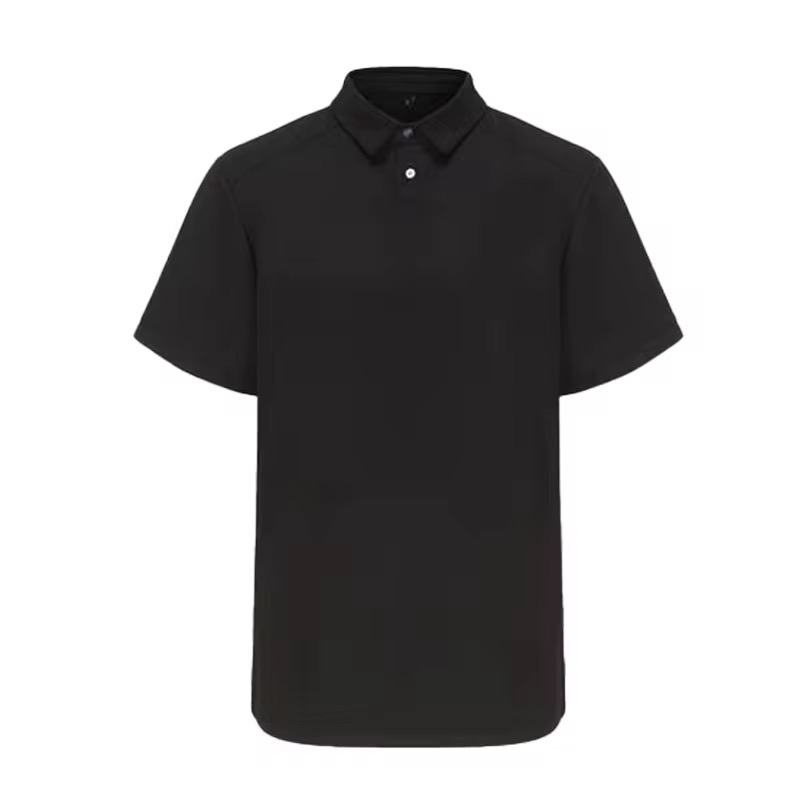
UHMWPE protective materials stabproof Polo
SECTION 52 — OBJECTIONS AND HONEST ANSWERS
Frequently Asked Questions
Will it be comfortable?
Comfort depends on garment design and material selection. Protective materials can affect weight, flexibility and breathability. The goal is to balance protection with comfort.
Will employees actually wear it?
Employee acceptance depends on comfort, appearance and practicality. Involving employees in testing can improve acceptance.
Is protective clothing too expensive?
Protective clothing typically costs more than standard uniform items. The additional cost should be considered against the value of employee protection and the potential long-term benefits.
Does every employee need it?
No. Protective clothing should be deployed based on risk assessment.
Can we add our logo?
Yes. Garments can be branded with logos and other corporate identifiers.
Can you supply 100+ employees?
Yes, subject to order quantities and lead times.
What happens when employees change size?
Replacement garments can be issued. A managed programme includes size exchanges.
What happens when garments are damaged?
Damaged garments should be replaced. Replacement programmes can handle this.
How often should garments be replaced?
Replacement frequency depends on garment type, usage and care. The programme should specify replacement intervals.
Can protective uniforms replace PPE?
No. Protective uniforms should not replace mandatory PPE.
Are protective garments certified?
Final certification depends on independent testing. At this stage, specific certification should be verified.
Can you provide samples?
Samples can be provided for evaluation.
Can you manage recurring replacement?
Yes, if a managed programme is in place.
Can we start with a pilot?
Yes, pilot programmes are recommended.
SECTION 53 — HOW TO CHOOSE A PROTECTIVE UNIFORM SUPPLIER
Buyer Checklist
- Testing evidence
- Certification
- Product documentation
- Manufacturing quality
- Sizing
- Samples
- Warranty
- Replacement policy
- Lead time
- Branding
- Procurement support
- Customer service
- Lifecycle management
- Data handling
- Insurance
SECTION 54 — IMPLEMENTATION ROADMAP
Illustrative Framework
Month 1 — Assessment
Risk assessment and supplier consultation.
Month 2 — Sampling and Fitting
Obtain samples, fit employees.
Month 3 — Pilot and Review
Deploy to limited group, gather feedback.
Month 4+ — Rollout
Organisation-wide deployment.
SECTION 55 — FINAL COMMERCIAL ARGUMENT
The Future of Protective Workwear
The future of protective workwear may not be about making workers look more protected. It may be about making protection a normal, professionally designed part of everyday work.
STABPROTECT™ represents a proposed opportunity to move from:
“selling protective clothing” to “protecting workforces”.
The ultimate commercial vision:
A business should be able to protect its people, standardise its uniforms, manage its workforce clothing and replenish its protective equipment through one professional programme.
Call to Action
Organisations interested in:
- Bulk orders
- Corporate uniform programmes
- Logo customisation
- Pilot programmes
- Workforce protection
- Procurement partnerships
- Managed replacement
- Recurring protection programmes
Should contact the STABPROTECT™ team to discuss their requirements.
SEO FAQs
1. What are protective company uniforms?
Protective company uniforms are professional work garments that incorporate discreet protective layers. Unlike traditional tactical equipment, these uniforms look like normal corporate clothing while providing additional protection for employees. They are designed for frontline workers, security personnel and public-facing staff who may encounter confrontation, aggression or violence as part of their work.
2. Who needs protective uniforms?
Protective uniforms may be appropriate for employees who face elevated risks while performing normal public-facing duties. This includes security officers, door supervisors, retail loss-prevention staff, delivery drivers, transport workers, housing officers, healthcare security personnel and many other frontline roles. The need should be determined through formal risk assessment.
3. Are protective uniforms the same as PPE?
No. Protective uniforms should not be considered a replacement for mandatory PPE. They may complement existing PPE but do not substitute for legally required personal protective equipment. The distinction between protective clothing and PPE is important when considering the regulatory requirements for each category.
4. How do discreet protective uniforms work?
Discreet protective uniforms incorporate protective layers into the garment construction. These layers are designed to provide resistance against sharp objects and other threats. The protective components are concealed within the garment so that the uniform looks normal. Final protection claims depend on independent testing and certification.
5. Can we add our company logo to protective uniforms?
Yes. Protective uniforms can be customised with corporate logos, company names, employee names, department identifiers and other branding. Customisation should be applied in a way that does not compromise the protective function of the garment.
6. What sizes are available?
Protective uniforms should be available in a range of sizes to accommodate different body shapes. Sizing becomes more complex when protective components are incorporated, so suppliers should provide detailed sizing guidance and individual fitting.
7. How do we order protective uniforms in bulk?
Bulk orders typically require a minimum order quantity determined by the supplier. Organisations should consider sampling, employee fitting, corporate approvals and delivery schedules. A managed programme can handle ongoing replacement and replenishment.
8. Can we start with a pilot programme?
Yes. Pilot programmes are recommended before full deployment. A controlled pilot allows organisations to gather feedback on comfort, usability, appearance, durability and operational suitability before committing to large-scale procurement.
9. What are the procurement considerations for protective uniforms?
Procurement professionals should evaluate product specifications, testing evidence, certification, warranty, lead times, minimum order quantities, pricing, volume pricing, replacement policy and supplier stability. Data protection, returns and sustainability should also be considered.
10. How do we ensure employees will wear protective uniforms?
Employee acceptance depends on comfort, fit, appearance and practicality. Involving employees in testing and procurement decisions can improve acceptance. Garments must be comfortable to wear throughout the working day.
11. How should protective uniforms be laundered?
Laundering instructions depend on the garment construction and protective materials. Final washing, drying and care instructions should be provided with the garments. Incorrect laundering can damage the protective layer and reduce protection.
12. What testing and certification do protective uniforms need?
Protective uniforms should be independently tested to demonstrate their protective properties. Testing should be performed by appropriate laboratories against relevant standards. Final certification should be verified before procurement.
13. Are protective uniforms required by UK law?
Employers are required to assess risks to employee health and safety under the Health and Safety at Work etc. Act 1974 and the Management of Health and Safety at Work Regulations 1999. Where risks are identified, employers must take reasonably practicable steps to control them. This may include providing protective equipment.
14. How long do protective uniforms last?
Garment longevity depends on the garment type, usage and care. A managed programme should specify replacement intervals. Damaged garments should be replaced immediately.
15. Can protective uniforms be used in healthcare settings?
Protective uniforms may be appropriate in healthcare settings where security personnel, transport staff or other workers face elevated risks. Deployment should be sensitive and proportionate, with a focus on safeguarding and de-escalation.
16. What is the cost of protective uniforms?
Indicative target prices are: Protective Polo £199–£299; Protective T-shirt £179–£249; Protective Hoodie £249–£349; Protective Jacket £399–£599; Complete Kit £499–£699+. These prices are working commercial targets and not confirmed market prices. Organisations should obtain current pricing and volume discounts directly from suppliers.
17. What is the Workforce Protection Programme?
The STABAPPAREL WORKFORCE PROTECTION PROGRAMME is a proposed recurring B2B service that includes protective uniforms, replacement programmes, size exchanges, employee fitting, corporate branding, priority support and annual inspection. It is designed to simplify workforce protection procurement.
18. Are protective uniforms suitable for all industries?
Protective uniforms may be suitable for security companies, door supervisors, retail security, transport and delivery companies, taxi and private-hire operators, healthcare security contractors, local authorities, event security, universities, schools and construction companies. Suitability should be determined through risk assessment.