Undetectable Knives & Workplace Safety: Employer’s Guide (UK/EU)
The New Duty of Care: Protecting Your Workforce from Concealed Knife Threats
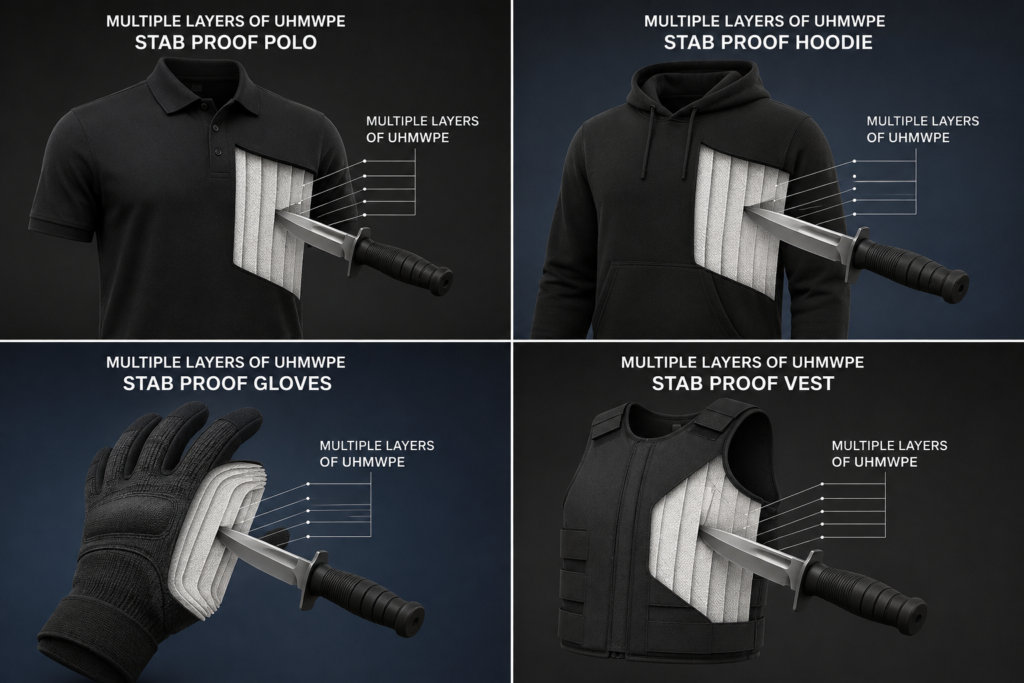
StabApparel UHMWPE Protective Gear
Introduction: The Shift from Reactive Safety to Proactive Protection
A shift supervisor at a city-centre store recently described a moment that reshaped her entire understanding of workplace safety. Nothing dramatic occurred—a customer became aggressive over a declined card, put his hand inside his jacket, and for three long seconds, the supervisor’s mind raced through scenarios her training had never covered. He wasn’t carrying anything, but the uncertainty had already taken its toll.
This is the new reality for modern UK employers. The gap between “is this person a threat?” and “no, they’re not” is where workplace safety strategies are being built. For businesses in retail, transport, hospitality, and healthcare, the question is no longer if they should plan for violence, but how.
This guide provides a clear, evidence-based look at a problem often discussed with more heat than light. We will analyse the true nature of concealed and difficult-to-detect blades, dissect the current UK knife crime data, and explain why a layered security strategy—including discreet protective clothing—is rapidly becoming a benchmark of responsible business practice.
1. The Real Concern: Why ‘Undetectable’ Doesn’t Mean ‘Unusual’
The term “undetectable knife” is often misused, creating confusion for employers trying to assess risk. It’s helpful to define the threat practically, not speculatively.
- An ordinary knife carried discreetly: This is the most common scenario. The weapon is an everyday utility knife or kitchen knife, hidden in a pocket or bag. It is not special in its construction, just out of sight.
- A knife difficult to spot casually: Small blades tucked into waistbands or jackets can be easily missed in a visual check.
- A weapon designed to evade detection tech: A much narrower, more specialist category often discussed in the context of security screenings at high-profile events.
For most UK employers, the crucial distinction is simple: if your workplace safety plan assumes you will see a weapon before an incident begins, your premise is fundamentally flawed. Most knife-related incidents start with a blade concealed from view. This single fact underscores why focusing on concealment and preventative measures is more critical than focusing on the weapon’s design.
2. The High-Risk Sectors: Who is Most Vulnerable?
The Health and Safety Executive (HSE) has long identified roles with direct public interaction, lone working, night shifts, cash handling, or positions of authority as carrying a higher exposure to unpredictable confrontation. This maps directly onto the sectors where discreet protection provides significant value:
- Retail: Staff handling refunds or challenging shoplifting.
- Hospitality: Door staff and late-night venue employees.
- Transport: Bus, rail, and taxi staff working without immediate backup.
- Healthcare: A&E, ambulance, and mental health teams facing patient distress.
- Security: Personnel whose role places them closer to conflict.
- Education & Local Authorities: Public-facing staff in high-risk settings.
It is no longer a matter of ‘if’ an employer is at risk from violence at work, but ‘when’—and this is why proactive measures are now essential to comply with a growing duty of care.
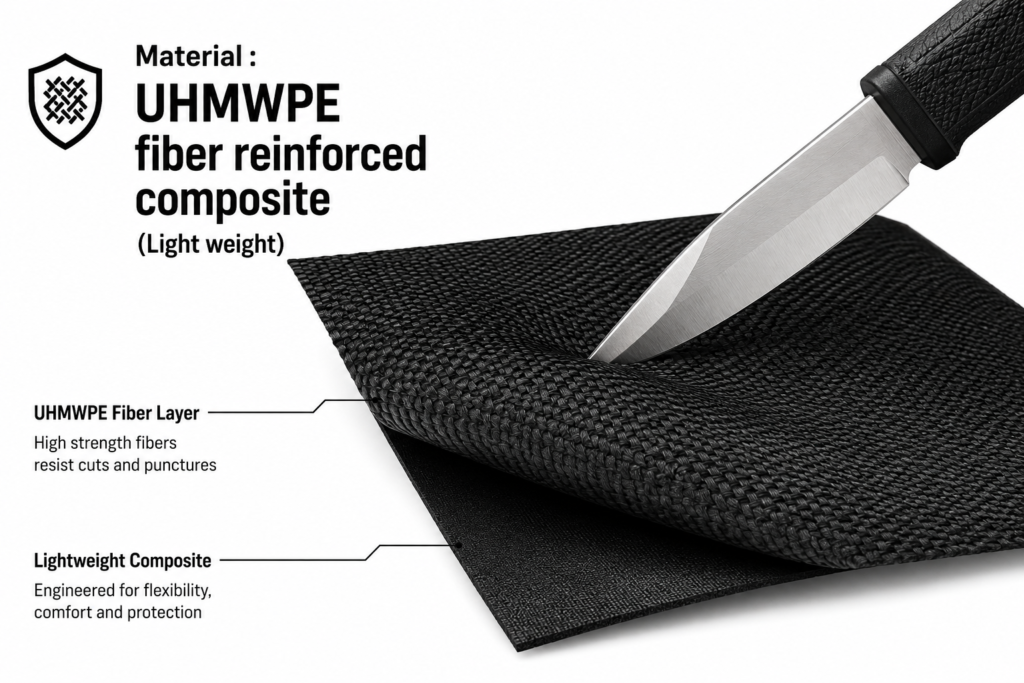
Stabproof clothing saintfabirc UHMWPE fiber
3. The Data: Knife Crime in England & Wales (2025/2026)
Understanding the data helps ground your risk assessment in reality, not sensationalism.
- Overall Knife Crime: Recorded offences involving a knife or sharp instrument in England and Wales fell by 10% in the year ending December 2025, from 54,548 to 49,151 offences .
- Knife Homicides: Homicides involving a sharp instrument fell by 21% in the same period, dropping from 217 to 172—the lowest number since records began in 2010/11 .
- Regional Variation is Key: Despite the national fall, risk remains highly concentrated. London accounted for 28% of all knife-enabled offences, a factor employers operating nationally must consider .
The Bottom Line: While headline statistics show improvement, the risk of a knife-related incident in a public-facing role remains a tangible reality. Public perception and legislative attention have intensified, even as figures improve, meaning the duty on employers is greater than ever.
4. The Legal Landscape: What Employers Must Know
The legal framework for UK employers has shifted significantly in the past two years, creating new obligations that go beyond standard security.
A. Prohibited Weapons
- Zombie-style Knives & Machetes: Banned from 24 September 2024 .
- Ninja Swords: Banned from 1 August 2025 as part of ‘Ronan’s Law’ .
B. The New Duty to Prevent Violence
- The Amended HSWA: A proposed amendment to the Health and Safety at Work etc. Act 1974 will place a clear duty on employers to adopt proactive and preventative measures to protect all workers from violence and harassment, including physical and sexual abuse and threats of violence .
- Implications: This explicitly requires a risk assessment to “eliminate these risks so far as is reasonably practicable” . This moves violence prevention from a “good practice” recommendation to a core legal duty, making protective measures like discreet body armour a more compelling solution for due diligence.
5. The Solution: Why Discreet Protective Clothing?
Traditional security measures are vital, but they are often reactive or easily circumvented. CCTV records an incident, but doesn’t prevent it. Access control manages entry, but not what someone brings in.
This is where a layered security strategy excels, and where discreet stab-resistant clothing offers a powerful, proactive layer of protection.
- Comfort & Discretion: Using advanced materials like UHMWPE, this clothing is designed to be lightweight, breathable, and virtually indistinguishable from regular workwear . It protects your staff without altering the professional appearance of your brand.
- Certified Protection: Look for garments tested and certified against recognised standards like EN388 (Levels 4/5 for cut and puncture resistance) . This provides verifiable protection, not just marketing claims.
- A Proactive & Compliant Measure: Implementing certified protective workwear is a demonstrable action showing you are taking the new legal duty of care seriously .
6. Why Choose StabApparel for Your Workforce Protection
StabApparel has established itself as the UK market leader by offering a solution that balances superior safety, absolute discretion, and undeniable comfort.
1. Advanced UHMWPE Composite Technology:
At the core of every StabApparel garment is an advanced Ultra-High Molecular Weight Polyethylene (UHMWPE) composite. This material provides an unparalleled strength-to-weight ratio, offering robust resistance against cuts and stabs without the bulk of traditional body armour.
2. Lightweight & Discreet Design:
Our design philosophy prioritises covert integration. Whether it’s a stab-proof t-shirt or a lightweight vest, our garments are virtually indistinguishable from regular clothing. Your staff stay protected without feeling like they are wearing tactical gear.
3. Multi-Layer Fibre Structure:
Our engineering creates a sophisticated multi-layer barrier designed to disperse impact energy and prevent penetration from bladed threats. This is not a single sheet of material; it’s a high-performance composite that causes blades to snag and lose kinetic energy.
4. Trusted by UK Professionals:
From security personnel and frontline NHS staff to retail workers and lone workers, StabApparel has earned the trust of a diverse clientele across the UK, consistently delivering on our promise of enhanced safety.
5. Certified & Reliable:
Our products are tested to meet rigorous European standards (e.g., EN388 Level 5 cut resistance), ensuring they are fit for purpose in the UK context. We provide clear, accurate information, empowering you to make an informed decision.
6. Seamless Fit & Whole-Workforce Viability:
We understand that a protective garment is only effective if it is actually worn. Our range includes inclusive sizing and is designed for comfort over a full shift, ensuring high employee acceptance and consistent protection across your workforce.
7. Commitment to UK Standards & Support:
We are a UK-focused company with free shipping and dedicated customer service to help you select the right solution for your risk assessment.

Non-Metallic Knives: Stealthy Stash Blades
7. Undetectable Knives & Workplace Safety: Employer’s Guide (UK/EU): Build a Resilient Workforce, Not a Fortress
Protecting your people is not just a legal requirement; it is a moral imperative and a cornerstone of business resilience. You don’t have to choose between appearing welcoming and taking employee safety seriously.
Combining proper risk assessment, staff training, and discreet protective clothing from StabApparel creates a workplace that is genuinely safer, more compliant, and more confident.
If you’re responsible for employee safety, now is the time to act.
[Contact us] to discuss a workforce protection consultation, or explore our [range of discreet protective uniforms] to see what fits your environment.
11. External Authority Links (sources referenced in this article)
- Office for National Statistics — Crime in England and Wales: year ending December 2025 (ons.gov.uk)
- Office for National Statistics — Crime in England and Wales: year ending March 2025
- House of Commons Library — Knife crime statistics: England and Wales briefing
- GOV.UK — ‘Ronan’s Law’ to see toughest crackdown yet on knife sales online
- BASC — Legislation on zombie-style knives and machetes
- Youth Endowment Fund — New legislation banning zombie-style knives comes into effect
- National Police Chiefs’ Council — Policing’s fight against knife crime strengthened with coordination centre
- HSE — Violence and aggression at work: guidance for employers (hse.gov.uk/violence)
- HSE — Managing the risk of violence and aggression
- NHS England — Violence Prevention and Reduction Standard
- Personal Protective Equipment at Work Regulations 1992 (legislation.gov.uk)
- Health and Safety at Work etc. Act 1974 (legislation.gov.uk)
Note: all statistics and legal details above were verified against these sources at the time of writing. Legislation and crime data are subject to change — employers should check current guidance before making compliance decisions.